


Patient reviews changed everything for my healthcare clients last year. One pharmacy jumped from page three to the local pack in just three months. Another pharmacy doubled its new patient bookings. The common factor? They finally understood how healthcare reviews impact local SEO.
Most healthcare providers know reviews matter. But few grasp the connection between patient feedback and where they appear on Google. Let me break down exactly how this works and what you need to do about it.
What You’ll Learn in This Blog
- Why Google treats healthcare reviews differently from other industries
- The exact percentage of reviews contributes to your local rankings
- How review volume beats star ratings (and why that matters)
- Simple tactics to generate reviews without breaking compliance rules
- Common mistakes that waste your review-gathering efforts
Why Healthcare Reviews Matter
Google classifies healthcare content as “Your Money or Your Life” (YMYL). This means search engines scrutinise medical websites harder than, say, a coffee shop or clothing store. The stakes are higher when someone’s searching for healthcare.
77% of patients use search engines before booking appointments, and nearly 75% check reviews first. That’s not just browsing. That’s active decision-making happening right in the search results.
When someone types “GP near me” or “pediatric dentist London,” Google needs to show safe, trusted providers. Patient reviews become the proof Google uses to make that call.
The 20% Factor: How Much Reviews Actually Matter
Reviews account for 15-20% of how you rank in the local pack (those top three results with the map). That’s enormous when you consider how many factors Google weighs.
However, what most guides overlook is that reviews also influence other ranking signals. When people see your 4.7-star rating with 200+ reviews, they click more often. That higher click-through rate? Google notices. It becomes another positive signal.
The actual impact is closer to 30% when these indirect effects are factored in.
Why are more reviews important?
I’ve watched healthcare providers obsess over maintaining a perfect 5.0-star rating. They’re afraid of a single negative review tanking their visibility.
Here’s the truth: Google’s AI reads your reviews for authenticity. A practice with 150 reviews and a 4.6 average will outrank a competitor with 15 reviews at 5.0 stars.
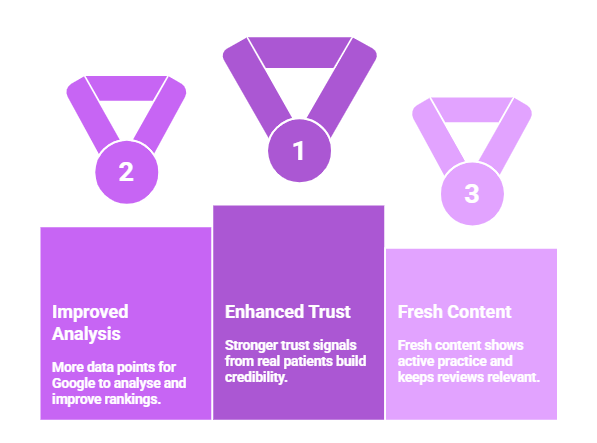
Why? More reviews mean:
- More data points for Google to analyse
- Stronger trust signals from real patients
- Fresh content that shows active practice
- Natural variation that looks authentic
The target? Aim for 4.5-4.7 stars with consistent volume growth. That’s the sweet spot.
Review Velocity: Is This Important?
A steady stream of new reviews shows Google you’re active and popular. This is called review velocity, and it matters more than your total count.
A pharmacy with 200 reviews but none in six months? Google sees that as stagnant. A clinic with 80 reviews but getting 5-8 new ones monthly? That signals growth and current patient satisfaction.
Platform Priority: Where Reviews Count Most
Not all review platforms carry equal weight. For optimising your Google Business Profile, Google reviews matter most because they feed directly into local rankings.
It’s Google reviews specifically that matter for local pack rankings. Reviews on Healthgrades, NHS Choices, or Facebook help reputation, but they don’t directly boost your map visibility.
My allocation strategy:
- 70% effort on Google reviews
- 20% on healthcare-specific platforms (like Healthgrades, Doctify)
- 10% on general platforms (like Facebook, Trustpilot)
Are Negative Reviews Bad for Rankings?
Here’s something that surprises providers: 38% of patients say they would switch doctors if they found better reviews elsewhere. But a few negative reviews won’t hurt you. In fact, they help.
Practices with 100% five-star reviews trigger spam filters. Google’s algorithm expects some variation. A 4.6 average with occasional three-star reviews looks more authentic than perfect scores.
The distribution that works:
- 65-70% five-star reviews
- 20-25% four-star reviews
- 5-10% three-star reviews
- Less than 5% one or two stars
Importance of Response to Review
Responding to reviews does two things simultaneously. It shows patients you care. And it shows Google you’re actively managing your online presence.
52% of patients trust online reviews as much as recommendations from friends or family. When those reviews have thoughtful responses, trust jumps even higher.
Response timing that improves rankings:
- Negative reviews: within 24 hours
- Positive reviews: within 48 hours
- All reviews: 80%+ response rate minimum
The response doesn’t need to be long. Just personal, professional, and HIPAA-compliant.
How to Get More Reviews (Without Breaking Rules)
You can’t incentivise healthcare reviews. No discounts, no rewards, nothing. But you can make the process easy.
The friction-free approach:
- Send review requests 24-48 hours after appointments
- Include direct links to your Google review page
- You can use SMS and email (SMS converts 3x better)
- Make it mobile-optimised (60% of reviews come from phones)
- Ask everyone equally
Do Keywords in review increase the business rankings?
When patients write detailed reviews, they use natural language that helps your local SEO. They mention symptoms, treatments, and services using words people actually search for.
A review that says “Dr Smith helped with my chronic back pain and the physiotherapy plan worked great” helps you rank for:
- Back pain treatment
- Physiotherapy services
- Chronic pain management
- [Specialist name + condition]
Google’s natural language processing extracts these connections automatically. The more detailed reviews you get, the more semantic associations you build.
The E-E-A-T Factor: Why Reviews Build Authority

Google’s E-E-A-T framework (Experience, Expertise, Authoritativeness, Trustworthiness) hits healthcare harder than any other industry. Reviews prove all four:
- Experience: Real patient stories show first-hand treatment experiences
- Expertise: Mentions of accurate diagnosis and effective treatment
- Authoritativeness: High volume across multiple platforms
- Trustworthiness: Consistent ratings over time with transparent handling
My clients following healthcare SEO strategies understand this. Reviews aren’t just reputation management. They’re authority building that Google measures and rewards.
What Mistakes Kill Review Strategies?
Mistake #1: Review gating: Asking patients about satisfaction before directing only happy ones to review sites? That violates FTC guidelines and platform policies. Ask everyone equally or don’t ask at all.
Mistake #2: Ignoring negative reviews: Every unanswered negative review tells prospective patients you don’t care. Worse, it tells Google you’re not engaged with feedback.
Mistake #3: Fake reviews: Google’s detection systems are sophisticated. Sudden review spikes, generic language, and new accounts – all trigger penalties. The risk isn’t worth it.
Mistake #4: Generic responses: “Thanks for your review!” repeated 50 times looks automated. Personalise each response with specific references to what the reviewer mentioned.
Mistake #5: HIPAA violations: Never discuss patient details in responses, even when patients mention specifics in their reviews. Keep responses general and invite offline discussion.
Measuring What Actually Matters
Track these metrics monthly to gauge your review strategy’s impact:
Review metrics:
- Total review count by platform
- Average rating (track by platform separately)
- Review velocity (new reviews per month)
- Response rate and average response time
SEO metrics:
- Local pack rankings for target keywords
- Google Business Profile views and clicks
- Direction requests and phone calls from the profile
- Website traffic from local search
The connection between review growth and ranking improvements usually shows within 60-90 days.
Are reviews important for Voice Search?
46% of patients use voice search to find healthcare providers. When someone asks Alexa or Siri for “best dentist near me,” the algorithm pulls heavily from review ratings and volume.
Voice assistants prioritise practices with:
- 4.5+ star averages
- High review volume
- Recent review activity
- Consistent ratings across platforms
Your review strategy directly impacts voice search visibility. As voice queries grow, this becomes even more critical.
What’s Next: Reviews in 2026 and Beyond
AI-powered search is changing how reviews influence rankings. Google’s algorithm now analyses review sentiment more deeply than simple star counts.
The future emphasis will be on:
- Review authenticity (genuine patient voices)
- Detail and specificity in review content
- Professional response quality
- Review recency and velocity
- Cross-platform consistency
Healthcare providers building strong review profiles now gain advantages that compound. Start small, stay consistent, and make it easy for satisfied patients to share feedback.
Final Thoughts
Reviews aren’t optional anymore. They’re a ranking factor you can actually control. Your clinical skills and patient care quality matter most. But if people can’t find you online, none of that matters.
Start this week. Ask your last five satisfied patients for reviews. Send them direct links. Respond to what you get back. That’s your foundation.
The practices dominating local search results aren’t doing anything magical. They’re just doing the basics consistently. You can too.