

Your client’s Google Business Profile is complete. NAP is consistent. Reviews are coming in steadily.
And still, a competitor with a weaker website is sitting above them in the Local Pack.
You’ve seen this. Most agencies have.
The gap, more often than not, is links. Specifically, locally relevant backlinks from sites that Google already associates with that service area. These are the signals that separate a ranking business from a stuck one.
This guide covers exactly what you need to do about it.
What you’ll learn:
- What earning local backlinks actually means and why it differs from standard link building
- What makes a local backlink worth your time
- 8 proven tactics to earn backlinks in any service area
- A real outreach email template you can send this week
- How to prioritise when you can’t do everything at once
- How to measure results without misleading your clients
- The most common mistakes agencies make
What Is Local Link Building?
Local link building is the process of earning backlinks from websites with geographic or topical relevance to your client’s service area.
That distinction matters more than most agencies realise.
A link from a high-authority national publication looks impressive in a monthly report. But it tells Google nothing specific about where your client operates.
Google ranks local results based on three factors: relevance, distance, and prominence. Backlinks contribute directly to prominence. And not just any backlinks. Links from websites that Google already recognises as part of that local digital ecosystem.
According to Whitespark’s Local Search Ranking Factors study, local links rank second among the most important signals for local organic results. Only Google Business Profile signals place higher.
That’s not a minor factor. That’s the thing your competitors are building while you’re focused elsewhere.
Local links vs citations
These are not the same thing. A citation is a mention of your client’s business name, address, and phone number (NAP) on a directory or listing site. It may or may not include a link to their website. A backlink points directly to their site – both matter. But backlinks carry significantly more ranking weight.
What Makes a High-Quality Local Backlink?
Not every link is worth building. Before you spend time on outreach, know how to judge an opportunity fast.
Geographic relevance
The linking site covers, operates in, or is associated with your client’s service area. A link from a local Chamber of Commerce tells Google something specific about where that business operates.
Topical relevance
The site’s subject matter connects to your client’s industry. A link from a local home improvement blog is more valuable than a link from a local pet care directory with no thematic connection.
Domain authority
Use Ahrefs or Semrush to check the referring domain’s DR or Authority Score. You don’t need a DR 80+ site. A DR 30 local newspaper backlink outperforms a DR 65 generic blog with zero local connection.
Placement
An in-content editorial link within a relevant article beats a footer mention or sidebar listing. Context around the link matters to how Google weighs it.
One rule worth keeping front of mind: three quality, locally relevant backlinks move local rankings faster than thirty low-quality directory submissions. This is not an opinion. It’s how local search actually works.
8 Proven Tactics to Earn Local Backlinks
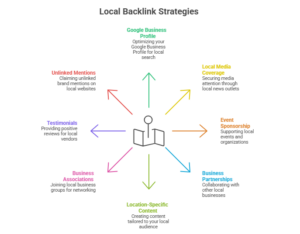
1. Start With Google Business Profile and Local Directories
This is your baseline, not your full strategy.
Audit your client’s listings using BrightLocal’s Citation Tracker or Semrush’s Listing Management. Make sure they appear on Google Business Profile, Bing Places, Yelp, the Better Business Bureau, and any industry-specific directories relevant to their niche.
A roofing company should be listed on Angi, HomeAdvisor, and local contractor directories. A restaurant should appear on TripAdvisor and local food guides.
Keep NAP identical across every listing. Even small discrepancies, like abbreviating “Street” to “St.”, dilute local trust signals.
2. Get Local Media Coverage
Local journalists need expert sources. Most businesses in your client’s area are not making themselves available.
That’s your opening.
Set up Google Alerts for your client’s target keywords combined with their city name. Use HARO (Help a Reporter Out) to respond to journalist queries in relevant industries. When a local story touches your client’s area of expertise, pitch them as a source.
Press releases work too. But only for genuinely newsworthy events: a business expansion, a community initiative, an award, a significant milestone. A press release about “spring services” is not newsworthy. That’s an ad with extra steps. (Your clients will try to disagree. Hold the line.)
A placement in a local newspaper or regional news site typically carries a DR of 40-65. That is one of the highest-value link sources available in any local market.
3. Sponsor Local Events, Teams, and Organizations
This is the most underused tactic in local SEO. It is also one of the most cost-effective.
Local nonprofits, school programs, community foundations, charity runs, and sports leagues all maintain websites. Sponsors typically receive a link from the event or organisation’s page. Many of these domains sit on .org or .edu addresses, which carry strong trust signals with Google.
The key is choosing sponsorships that align with your client’s brand and service area. A law firm sponsoring a local 5K run gets a real link, real community visibility, and a real local-relevance signal.
Many local sponsorships start at $250-$500. Compare that to the cost of most paid outreach campaigns, and the ROI is clear.
4. Build Local Business Partnerships
Find non-competing businesses that serve the same audience as your client.
A real estate agent and a mortgage broker. A wedding photographer and a florist. A gym and a sports nutritionist. The pairing depends on the industry, but the logic is always the same: find a business with the same customers and no competitive overlap.
Propose a reciprocal resources page, a co-written local guide, or a cross-promotion on each other’s blogs. The link you earn is local, relevant, and editorially placed.
Here is an outreach email template your account managers can use right now:
Subject: Partnership idea for [City] businesses
Hi [Name],
I work with [Client Name], a [service type] based in [City]. I’ve been following what you’re doing at [Their Business Name] and think our audiences overlap quite a bit.
We’re putting together a local resource guide for [target audience, e.g., “first-time homebuyers in Denver”] and would love to feature your business. In return, we’d appreciate a mention in your resources section.
Would a 15-minute call this week work?
[Your name]
Short. No jargon. Clear value exchange. This kind of email gets replies.
5. Create Location-Specific Content
Generic content earns generic links. Local content earns local links.
Not “7 Tips for Homeowners.” Think “Best Time of Year to Replace Your Roof in Phoenix” or “What Tampa Homeowners Should Know Before Hiring a Foundation Contractor.”
Content like this attracts links from local blogs, real estate sites, neighbourhood forums, and community organisations. It also ranks for long-tail local keywords with strong purchase intent.
The rule: write content that could only exist for that specific location.
6. Join Local Business Associations
Chamber of Commerce membership almost always includes a link from the member directory. The same applies to BNI chapters, Rotary clubs, local business improvement districts, and industry association chapters with a local presence.
These links sit on high-trust, often long-established domains. A Chamber of Commerce link sends a clear geographic relevance signal that generic directories cannot replicate.
For many clients, the membership fee is already justified by networking and referrals alone. The backlink is the benefit most people forget to count.
7. Write Testimonials for Local Vendors
This tactic is simple and consistently overlooked.
Pick five local vendors or suppliers your client genuinely uses: their accountant, their printing shop, and their office cleaning service. Write them a short, specific testimonial.
Most businesses will publish it on their website with a link back to your client’s site. It takes about 20 minutes per testimonial. It earns a real, editorially placed, locally relevant backlink.
Scale this to ten vendors, and you’ve built a meaningful slice of a local backlink profile with almost no outreach friction.
8. Reclaim Unlinked Brand Mentions
This is the highest-conversion outreach tactic available.
Local news articles, blog posts, and community pages regularly mention businesses by name without linking to their website. Use Ahrefs Content Explorer or a simple Google search for your client’s business name to find those unlinked mentions. Then send a short, friendly note to the editor or webmaster:
“Hi, I noticed your article mentioned [Client Name]. Would you be open to adding a link to their website for readers who want to learn more? Here’s the URL: [link].”
Unlinked mention outreach typically converts at 20-40%. The publication already knows the business. You’re simply asking for what should have been there from the start.
How to Prioritise When You Can’t Do Everything
You can’t run all eight tactics for every client simultaneously. Here’s how to sequence them.
Quick wins (first 30 days):
- Unlinked brand mention reclamation
- Local directory submissions
- Vendor testimonials
Medium-term (next 60 days):
- Association memberships
- Business partnerships
- Event sponsorships
Long-term investment (ongoing):
- Local media relationships
- Location-specific content
Start with the quick wins. They generate early movement and give you something real to show clients before the slower, higher-value sources start paying off.
How to Measure What’s Working
Track these metrics every month:
| Metric | Tool |
| Referring domain growth | Ahrefs / Semrush |
| Local Pack ranking movement | BrightLocal / Whitespark |
| Organic local keyword traffic | Google Search Console |
| GBP actions (calls, directions, clicks) | Google Business Profile Insights |
| Domain Rating / Authority Score | Ahrefs / Semrush |
Set a 90-day baseline before drawing conclusions.
This work compounds. The first two months often feel slow. That’s normal. Clients who expect ranking spikes in week three push agencies toward shortcuts that eventually hurt the rankings they’re trying to build. Set expectations upfront, then hold to them.
Common Mistakes to Avoid
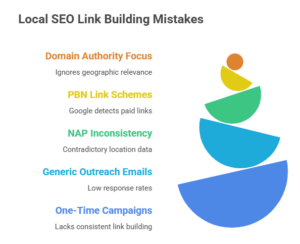
Prioritising domain authority over geographic relevance. A DR 70 site with no local connection moves a national strategy. It doesn’t move the Local Pack.
Buying links from private blog networks (PBNs). Google’s local algorithm is increasingly effective at detecting paid link schemes. One manual action can erase months of legitimate work.
Ignoring NAP consistency while building links. You’re adding link signals while simultaneously sending contradictory location data. Fix the citations before you build links.
Sending generic outreach emails. “We’d love to collaborate”, sent to 50 websites, returns a handful of replies, most of which are useless. Personalisation is not optional; it’s the difference between a 2% and a 30% response rate.
Treating link building as a one-time campaign. The agencies consistently winning local SEO for their clients build links every month, not in short bursts between reporting cycles.
Final Thought
No shortcut replaces real relationships, genuine community presence, and content that people in a specific area actually find useful.
Most agencies already know this. The ones falling behind aren’t missing knowledge. They’re missing consistency.
Three quality local links a month compound into something your client’s competitors cannot easily reverse-engineer. It becomes a durable local authority that holds through algorithm updates and market shifts.
Start with the quick wins this week.
Build the relationships next month.
The rankings follow.