

Key Result:
- 12,600 AI search impressions from Google AI Overviews in 30 days
- Total Clicks growth (+532.14%)
- Total Impressions growth (+363.47%)
- Average CTR growth (+33.33%)
- Average Position improvement (+32.82%)
The Challenge
This Tampa personal injury firm had a visibility problem. And not a small one.
People were searching for legal help after accidents. Car crashes. Slip-and-falls. Workplace injuries. But this firm wasn’t showing up. Not in Google’s Local Pack. Not in Maps. And definitely not in the AI tools like ChatGPT, Perplexity, or Google AI Overviews that more people now use before they ever pick up a phone.
That last part is what made this case different.
Search behavior has shifted fast. People don’t scroll ten blue links anymore. They ask an AI a question and expect a name. A recommendation. A direct answer. If your firm isn’t in that answer, you don’t exist to that searcher. Simple as that.
The firm also had some foundational issues holding them back. Their Google Business Profile was under-optimized. Their practice area pages weren’t structured for how Google reads and rewards content today. And their local citation profile had inconsistencies that quietly hurt their Maps rankings.
On top of all that, personal injury law in Tampa is brutally competitive. Big firms. Big ad budgets. Firms that have been investing in SEO for years. Walking into that market without a solid strategy isn’t brave. It’s just expensive.
So the goal wasn’t just to rank. It was to become the default answer. The name that comes up when someone in Tampa asks an AI who to call after a car accident.
That’s a much higher bar than traditional SEO.
Our Approach
When we took this on, we knew standard SEO tactics alone wouldn’t cut it.
Ranking on page one is one thing. Getting cited by AI systems is another. We needed to do both at the same time – and make sure every layer of the strategy fed into the other.
So we ran a combined AI SEO, GEO, and AEO strategy. Three disciplines. One goal. Make this firm impossible to miss, whether someone is Googling, asking ChatGPT, or checking Maps.
Here’s how the work broke down:
| Focus Area | What We Did |
| AI SEO | Structured content and technical signals so AI models could surface the firm accurately and confidently |
| GEO (Generative Engine Optimization) | Optimized for how ChatGPT and Perplexity pull and cite answers from the web |
| AEO (Answer Engine Optimization) | Formatted content to directly answer common legal questions, raising the odds of the firm being the cited source |
These three aren’t separate projects. They overlap constantly. A page built well for Google AI Overviews almost always performs in Perplexity too, because both systems reward the same things – clear writing, trustworthy sourcing, and direct answers.
We also fixed the basics first because none of the AI-layer work matters if the foundation is broken.
Here’s what the full scope looked like:
- Google Business Profile overhaul – updated categories, added Q&As, fixed inconsistent NAP data across directories, and built a steady review acquisition process
- Technical SEO fixes – resolved crawl errors, improved Core Web Vitals, cleaned up site architecture, and implemented attorney schema markup
- Practice area page rewrites – restructured key pages so they ranked, loaded fast, and answered exactly what someone searching for a Tampa personal injury lawyer actually wanted to know
- Entity optimization – made sure the firm was recognized as a legitimate, authoritative legal entity by Google’s Knowledge Graph
- Topical content build-out – created content around real questions people ask after accidents in Florida: what to do after a crash, how comparative negligence works, what a typical settlement timeline looks like locally
That last piece mattered a lot. AI systems don’t cite thin content. They cite pages that actually answer questions well. So we wrote content that an AI would want to reference – not for keywords, but for clarity and usefulness.
This approach aligns with what we do across all our law firm SEO work at Crazygraph. We treat rankings as a means to an end. The end is booked consultations and real cases. Everything else is just a number.
Our Results
The numbers came in fast. Faster than we expected, honestly.
Within the first 30 days, the firm generated 12,600 impressions from Google AI Overviews alone. That’s 12,600 instances where Google’s AI surfaced this firm’s content as part of a direct answer to a real search query.
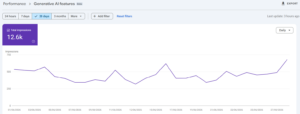
By the end of month three, organic performance achieved significant growth across all key metrics.
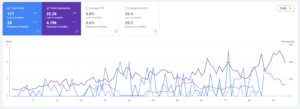
| Metric | Last 3 months | Previous 3 months | Change |
| Total Clicks | 177 | 28 | +532.14% |
| Total Impressions | 22.2k | 4.79k | +363.47% |
| Average CTR | 0.8% | 0.6% | +33.33% |
| Average Position | 26.4 | 39.3 | +32.82% higher visibility |
The Local Pack results followed. For their primary target terms, the firm moved into the top three map positions – visibility that simply wasn’t there before we started.
Here’s a quick snapshot of where things stood:
| Metric | Result |
| AI Overview impressions (30 days) | 12,600 |
| Organic traffic growth (3 months) | +532.14% |
| Local Pack visibility | Top 3 for primary target terms |
| Google Business Profile | Fully optimized with active review flow |
For a market as competitive as personal injury law in Tampa, that’s a meaningful shift in a short time.
The firm went from invisible to present – across Maps, traditional search, and the AI tools that more people now consult before they ever call a lawyer. That’s what law firm SEO in Tampa looks like when it’s built for how people actually search in 2026.
Not just rankings. Real visibility. Everywhere your future clients are already looking.