The Challenge
This London immigration solicitors firm had a working website. It just wasn’t working for them.
Between June 2025 and December 2024, the firm pulled in just 254 organic clicks from Google Search – with a total of 7,720 impressions. For an immigration law firm competing in one of the most contested legal markets in England, those numbers are about as impactful as a whisper outside the Royal Courts of Justice.
Our audit flagged three clear problems.
First, the firm had almost no visibility for immigration law searches in London – bigger, better-funded competitors had claimed the top spots, and this firm wasn’t close to page one.
Second, there was zero preparation for AI-powered search. Google’s AI Overviews were already reshaping how people find solicitors, and the site had no entity signals that AI systems could recognise or cite.
Third, the local presence was weak. Minimal Local Pack appearances meant the firm was invisible to the majority of nearby searchers.
None of this reflected the quality of their legal work. It was a pure visibility problem. Fortunately, that’s exactly what we fix.
Our Approach
We built this campaign around The Signal Method – Crazygraph’s proprietary AI SEO framework built specifically for law firms that need to show up in both traditional Google results and AI-generated answers.
Most law firm SEO campaigns chase keywords. That’s not enough anymore. Our Signal Method focuses on making the firm a clearly understood, trusted entity – so when Google’s AI systems or the Maps algorithm encounter a search like “immigration solicitor in London,” they can confidently connect that query to this firm.
Here’s what we actually did:
Entity & AI SEO Optimisation
We mapped and structured the firm’s core entities – practice areas, location signals, and expertise markers – across the website. Schema markup, semantic content clusters, and E-E-A-T signals were all built out properly. This is what gets a firm cited in AI Overviews, not just ranked on page one.
Local SEO & Google Business Profile
We fully optimised the firm’s Google Business Profile, rebuilt its local citation footprint across trusted UK directories and London-specific listings, and cleaned up NAP consistency. Local pack visibility doesn’t happen by accident. It takes deliberate groundwork.
Authority Signals
We supported the above with targeted link-building – guest placements on legal and immigration sites, and press release distribution across trusted outlets. Roughly 45 links from DA 55+ domains, earned at a 9% outreach publish rate.
Every step was sequenced to build early local momentum while establishing long-term AI search visibility in parallel.
The Result
The six months from December 2025 to May 2026 told a very clear story.
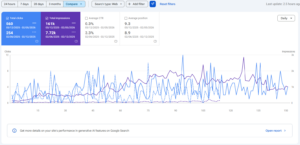
GSC Screenshot
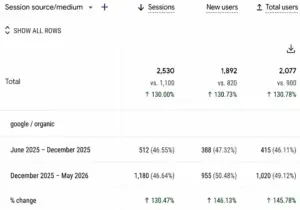
GA4 Screenshot
| Metric | Before (Jun 2025 – Dec 2025) | After (Dec 2025 – May 2026) | Change |
| New Organic Users (Google Search) | 388 | 955 | +146% |
| Organic Clicks (GSC) | 254 | 560 | +120.47% |
| Total Impressions (GSC) | 7,720 | 161,000 | +1,985.49% |
| Average CTR | 3.3% | 0.3% | -90.91% |
| Local Pack Appearances | Minimal | Top 3 for 11 key London immigration queries | Significant growth |
The headline number is the jump in impressions. From 7,720 to 161,000 – nearly 2,000% growth. That means the firm went from being practically invisible on Google to appearing in front of a vastly larger pool of potential clients across a much wider range of searches.
Clicks more than doubled. Organic users grew by 146%. And the Local Pack gains were arguably the most commercially valuable part – the firm now appears in the top 3 map results for 11 high-intent immigration queries across London boroughs. That’s the spot where most local clients actually call from.
The CTR dip is worth a quick note. It dropped because impressions exploded across broader, top-of-funnel queries where click-through is naturally lower. More visibility, earlier in the funnel. That’s a good problem to have.
The phone followed the traffic. The firm reported a significant rise in inbound calls from new clients, which converted into retained cases – revenue went up, higher-profile immigration matters started arriving, and the solicitor hired additional lawyers to handle the growing caseload.
They are still an active client. And the numbers are still climbing.