

92% of people looking to hire a lawyer start their search on Google.
Not Avvo. Not a referral from a friend. Google.
That number comes from a 2025 iLawyer Marketing survey, and it tells you exactly where your next client begins their journey. The challenge is that Google’s first page has limited space, the competition in legal search is fierce, and most firms are burning through Google Ads budgets, hoping paid clicks will fill the gap.
SEO solves a different problem. It builds visibility that keeps working after the campaign ends.
In this guide, we cover everything you need to know.
What you’ll learn:
- What attorney SEO actually includes, and what most firms get wrong
- Why organic search outperforms paid ads for long-term client acquisition
- How Google evaluates legal websites differently from every other industry
- How to find and target the right keywords for your practice area
- On-page, technical, and local SEO for attorneys
- How to convert organic traffic into actual consultations
- How long results realistically take for a law firm
- What to look for when hiring an SEO agency
What is law firm SEO?
Law firm SEO is the process of making your website appear in Google’s organic (unpaid) search results when potential clients search for legal help.
The goal is to rank for searches like “personal injury attorney in Chicago” or “criminal defense lawyer near me” without paying for each click. Done right, it means your site attracts qualified visitors around the clock, regardless of whether you have an active ad budget running.
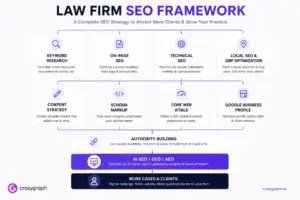
It covers four core disciplines:
- Technical SEO: Site speed, mobile performance, crawlability, and indexation
- On-page SEO: Optimizing individual pages with the right content, headings, and metadata
- Local SEO: Visibility in Google Maps and the Local Pack for location-based searches
- Link building: Earning backlinks from credible sources to build domain authority
These four things work together. Technical issues limit how far good content can rank. Great content without links struggles to break through competitive searches. Strong local SEO without a properly optimized site converts poorly.
The firms that grow consistently through organic search treat all four as ongoing work, not one-time tasks.
Explore our guide to effective SEO strategies for small law firms to see how these elements work together in practice.
Why law firms need SEO
Let’s start with what paid advertising actually costs in legal.
Legal keywords are among the most expensive in all of Google Ads. The average law firm or attorney running PPC campaigns spends around $9,000 to $10,000 per month, according to HawkSem. Click costs for terms like “personal injury lawyer” can run $50 to $300+ in mid-sized markets. In New York City or Los Angeles, some terms push past $1,000 per click.
That spending can generate clients. But it stops generating them the moment you cut the budget.
SEO works on a fundamentally different model. The rankings you build in month eight don’t disappear in month nine. A well-optimized practice area page can generate consultation requests for two or three years after it was written. That’s compounding return on a fixed investment.
There’s also the trust dimension. Most users click organic results over paid ads, especially for high-stakes decisions like hiring a lawyer. When someone searches “DUI attorney in Seattle” and your site appears at the top of organic results, that placement carries credibility that an ad label doesn’t.
If you’re currently deciding between SEO and paid search, our comparison of legal SEO vs. Google Ads ROI breaks down the numbers side by side.
How Google evaluates law firm websites
Here’s where legal SEO gets meaningfully different from optimizing a restaurant or an e-commerce store.
Google classifies legal content as YMYL: Your Money or Your Life. Bad legal information can genuinely harm the person reading it. Because of that classification, Google holds legal websites to a higher standard of trust and quality before ranking them.
The framework behind that evaluation is E-E-A-T.
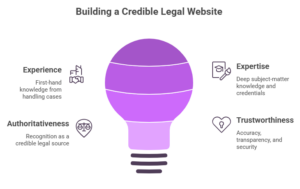
Experience is about first-hand knowledge. A page explaining what to do after a car accident should reflect the experience of handling those cases, not a generic summary written by someone who has never stepped into a courtroom.
Expertise is demonstrated subject-matter knowledge. Attorney credentials, bar admissions, years of practice in a specific area, and content that goes deeper than what a quick Google search could produce all contribute to this signal.
Authoritativeness means your site is recognized as a credible source within the legal space. Backlinks from bar associations, law school websites, legal publications, and established legal directories tell Google your site belongs near the top.
Trustworthiness covers accuracy, transparency, and security. HTTPS, clear attorney contact information, proper legal disclaimers where required, and factually verifiable content all play a role.
This is why law firm websites built on thin, templated content rarely compete in organic search long-term. Google’s quality raters are trained specifically to assess whether a legal page can be trusted with the query it’s trying to answer.
How to Do Keyword research for law firms
Before optimizing anything, you need to understand what potential clients are actually searching for.
The most common mistake is targeting only the obvious high-volume terms. “Personal injury lawyer” is searched thousands of times per month, but it’s also contested by firms with years of domain authority and substantial content libraries. A firm starting its SEO program today is unlikely to rank for that term quickly, and it will be frustrating for the first year.
A more effective approach is building a layered keyword strategy:
Practice area plus location terms are your primary commercial targets. “Car accident lawyer in Dallas” or “family law attorney near Phoenix” signals clear hiring intent. These are the people who currently have a problem and are actively looking to hire someone.
Long-tail informational queries bring in potential clients earlier in their decision process. Someone searching “what happens if I don’t file a police report after an accident” is not yet in hiring mode. But they’re reading. And if your site answers that question clearly, you’re the first attorney they’ve interacted with. That matters when they eventually pick up the phone.
Near me searches deserve special treatment. Searches like “lawyer near me” or “attorney near me” have grown year over year and are heavily influenced by local SEO signals rather than traditional on-page optimization. We’ll cover those in detail below.
The mapping principle: one focused page per topic. Don’t create three pages targeting slight variations of the same term. A single, thorough page on “truck accident attorney in Houston” will outrank three thin variations every time, because Google sees depth and comprehensive coverage as quality signals.
Understanding search intent behind legal queries
Not all searches mean the same thing, even when they look similar. “Personal injury lawyer” and “do I need a personal injury lawyer” are two very different queries from two very different people.
Google categorizes search intent into four types: informational (learning something), navigational (finding a specific site), commercial investigation (comparing options), and transactional (ready to act). For law firms, the last two categories are where the highest-value traffic lives.
A search like “best personal injury lawyer in Miami” is commercial. The person is comparing options. They want to see your credentials, your results, and why your firm is worth calling.
A search like “hire personal injury attorney Miami” is transactional. They’re ready to act. Speed to contact matters enormously here.
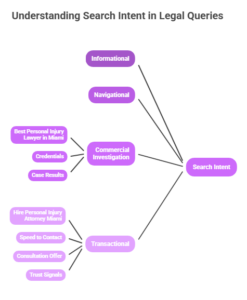
Understanding the intent behind each keyword tells you what that page needs to do. A page targeting a transactional query should lead with your phone number, a consultation offer, and trust signals. A page targeting a commercial query should lead with credentials, case results, and what makes your approach different.
Mismatching your content to the intent behind the query is one of the most common reasons technically optimized pages don’t rank well.
Keyword research tools for legal practices:
| Tool | Best used for | Cost |
| Google Search Console | Seeing what you already rank for, finding quick wins | Free |
| Google Keyword Planner | Volume and CPC data for paid/organic planning | Free |
| Ahrefs | Competitor keyword gap analysis, backlink research | Paid, free trial available |
| Semrush | Full keyword research suite, local visibility tracking | Paid, free trial available |
| Moz Pro | Domain authority checking, SERP feature tracking | Paid, free trial available |
Google Search Console (free), Ahrefs, and Semrush are the standard tools for identifying what searches you’re already appearing for and where the ranking gaps are.
On-page SEO for law firm websites
On-page SEO is the work you do on individual pages to tell both visitors and search engines exactly what each page is about and why it deserves to rank.
Every law firm website needs these pages at a minimum:
- Homepage with a clear statement of what your firm does and where
- Individual practice area pages, one per service
- Attorney bio pages for each lawyer at the firm
- Location pages if you serve multiple cities or regions
- A blog or legal resources section
- A contact page with phone number, address, and a consultation form
The practice area pages carry most of the SEO weight. Here’s what separates strong ones from weak ones:
The title tag should include the practice area and city. “Personal Injury Attorney in Houston | [Firm Name]” is clear and specific. It tells Google what the page is about and tells a searcher whether they’re in the right place.
The H1 heading should match the intent behind the search. “Experienced Personal Injury Lawyer in Houston” works. “Welcome to Our Firm” does not.
Content depth matters more than word count, but competitive practice area pages typically need 800 to 1,500 words to rank well. That depth should cover what the legal process looks like for the client, what outcomes are realistic, how your firm handles these specific cases, and what questions first-time clients typically have.
Attorney bio pages are underestimated by most firms. Google factors in the credentials, experience, and bar memberships of the attorneys writing or overseeing legal content. A complete bio page with bar admission information, practice history, and published writing functions as an E-E-A-T signal in ways a generic one-paragraph bio doesn’t.
Schema markup is where most law firm websites leave rankings on the table. Adding structured data to your pages gives Google explicit, machine-readable information about your firm. The most relevant schemas for legal websites are:
| Schema type | What it signals to Google |
| LegalService | Your firm type, jurisdiction, practice areas |
| Person / Attorney | Individual attorney credentials and affiliation |
| FAQPage | Question-and-answer content eligible for rich results |
| AggregateRating | Client review scores, eligible for star display in SERPs |
| LocalBusiness | Address, phone, hours, geographic service area |
Most legal websites have none of these implemented. That’s an opportunity.
Technical SEO for law firm websites
Technical problems don’t just slow down SEO. They can make all your other work irrelevant.
The three issues we see most often on law firm websites:
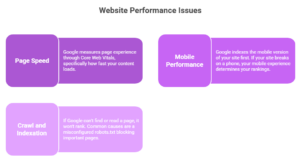
Page Speed Issue:
Google measures page experience through Core Web Vitals, specifically how fast your content loads (LCP), how stable the layout is during loading (CLS), and how responsive the page is to interaction (INP). A site that takes four seconds to load on mobile will lose to a competitor’s site that loads in under two seconds, even if your content is better. Google’s PageSpeed Insights and Search Console’s Core Web Vitals report show you exactly where you stand.
Mobile Performance Issue:
Google indexes the mobile version of your site first. If your site looks polished on desktop but breaks on a phone, your mobile experience is what determines your rankings. Run your site through Google’s Mobile-Friendly Test. Pay particular attention to tap target sizing, font readability, and whether your contact forms and phone number are easily usable on a small screen.
Crawl and Indexation Issue:
If Google can’t find or read a page, it won’t rank. Common causes are a misconfigured robots.txt blocking important pages, pages accidentally tagged as “noindex,” an outdated XML sitemap, or broken internal links leaving pages stranded. Google Search Console’s Coverage and Indexing reports show you exactly which pages are indexed and flag anything preventing access.
HTTPS is non-negotiable. If your site still runs on HTTP, browsers display a “Not Secure” warning to every visitor. Google confirmed HTTPS as a ranking signal years ago. There is no justification for leaving this unaddressed.
Duplicate content is also a persistent problem on legal websites, particularly for firms targeting multiple cities with nearly identical pages. If you have ten location pages that share 90% of the same text, Google will struggle to determine which one to rank and may rank none of them well. Each location page needs genuinely distinct content.
What a technical SEO audit looks for on a law firm site
A proper technical audit of a law firm website checks more than the obvious issues. Here’s what tends to surface on sites that have never been professionally audited:
Orphaned pages. Practice area pages have no internal links pointing to them. If Google can only find a page by stumbling upon it, not by following links from your homepage or other important pages, that page has no authority flowing to it and will rank poorly regardless of its content quality.
Redirect chains. Old URLs redirect to other redirects before reaching the final destination. Every additional hop in a redirect chain loses a fraction of the link equity that was pointing to the original URL. Common after website redesigns that weren’t properly managed.
Missing meta descriptions. Google will auto-generate meta descriptions when yours are absent, and the results are rarely optimal for click-through rate. In a competitive legal search result, the difference between a well-written meta description and an auto-generated one can meaningfully affect whether someone clicks your listing or the one below it.
Slow images. Uncompressed photos of your attorneys and office are a frequent culprit behind poor load times on legal websites. Images should be compressed, served in modern formats like WebP, and sized appropriately for the containers they appear in.
These aren’t glamorous fixes. But they’re the foundation everything else sits on.
Why is local SEO important for law firms
Most legal services are inherently local. A personal injury attorney in Miami is not competing with one in Seattle. The client needs a licensed attorney in their state, ideally within a reasonable distance.
This is why local SEO often delivers the fastest and most measurable results for law firms, especially those in competitive markets where organic rankings take time to build.
Dig deeper: The Complete Guide to How to Improve a Law Firm’s Local SEO
The Google Local Pack is where the opportunity sits. When someone searches “divorce lawyer near me” or “DUI attorney in cleveland ohio,” Google shows a map with three business listings above the organic results. Getting into that pack for high-intent legal searches can generate more calls than ranking on page one of organic search.
Your Google Business Profile (GBP) controls whether you appear there.
To get your GBP working properly:
- Choose the most accurate primary category (“Personal Injury Attorney” rather than the generic “Lawyer”)
- Add every practice area you handle as additional services
- Upload photos of your office, team, and building exterior so clients recognize you on arrival
- Keep your Name, Address, and Phone number exactly consistent across every online listing, every directory, and your own website. Even small variations confuse Google’s local algorithm.
- Respond to every review, positive and critical alike
How to optimize your Google Business Profile for maximum visibility
Your GBP is not a one-time setup. It’s an active asset that rewards consistent attention.
The description field (up to 750 characters) is your chance to tell both Google and potential clients what your firm does, where you practice, and what makes your approach different. Write it as if a potential client will read it, not as a keyword list.
Google Posts let you publish short updates directly to your GBP that appear in local search results. Law firms that use them regularly to share legal tips, firm news, or case wins (with appropriate anonymization) signal to Google that the profile is active and managed, which influences local ranking.
The Q&A section is often ignored. Anyone can submit questions to your GBP, and anyone can answer them, including random people who may not know what they’re talking about. Check it regularly, answer legitimate questions yourself, and flag inaccurate answers.
For firms serving clients across multiple practice areas, your service list should be exhaustive. Don’t just list your primary practice area. If you handle personal injury, wrongful death, slip-and-fall, and workers’ compensation, list all of them. Google uses this information to match your profile to specific searches.
For a complete breakdown of GBP optimization for law firms and solicitors, our complete Google Business Profile guide for attorneys covers every field and feature in detail. And if your GBP is set up but not showing in local results, our guide on why your Google Business Profile isn’t appearing walks through the most common causes.
Moz’s Local Search Ranking Factors research consistently places review signals among the top determinants of Local Pack position. A firm with 85 reviews at 4.7 stars will consistently outrank a comparable firm with 12 reviews at 3.9 stars, assuming other signals are similar.
On the ethics side, the ABA Model Rules prohibit offering incentives for reviews. You can ask satisfied clients to leave a review; you cannot offer a discount or gift in exchange. Know your state Bar’s specific rules, as they vary.
The second pillar of local SEO is citation building, which means consistent mentions of your firm’s name, address, and phone number across the web. Legal directories like Avvo, Martindale-Hubbell, FindLaw, Justia, and Super Lawyers are the highest-value citation sources for attorneys. They rank well in their own right and send referral traffic directly, in addition to the citation value.
For a full step-by-step process, our guide to building local citations for law firms covers every directory worth prioritizing and the exact information to include.
For firms with multiple office locations, each location needs its own separate GBP listing and its own distinct landing page on your website. Pointing all locations to a single generic contact page will limit your local rankings across the board.
Content strategy for law firms
Here’s an objection we hear from attorneys regularly: “Why would I explain how the legal process works for free? Won’t that stop people from hiring me?”
It won’t. It does the opposite.
Someone who reads your article about what to do after a slip-and-fall accident is not going to represent themselves because you explained the process. They’re going to call the attorney who demonstrably knows what they’re talking about. They already found that person. It’s you.
Content builds topical authority. The more thoroughly your site covers the questions and topics within your practice area, the more Google recognizes your site as a serious resource on those subjects. That recognition improves rankings across all related pages, not just the one you published.
The most effective structure for a law firm content strategy is a pillar-and-cluster model.
Your practice area pages are the pillars. They target the main commercial terms (“Personal Injury Attorney in [City]”) and cover the topic at a broad level.
Your blog posts are the clusters. These target the specific questions potential clients ask within that practice area.
For a personal injury firm, that looks like this:
Pillar: Personal injury attorney in [City]
Cluster articles:
- How long does a personal injury claim take to settle
- What is a contingency fee and how does it work
- When should you accept a settlement offer
- What to do if the at-fault driver has no insurance
- How do pre-existing conditions affect a personal injury case
Each cluster article links back to the pillar page. The pillar links to the most relevant clusters. This structure signals to Google that your site covers personal injury law comprehensively, which strengthens the pillar page’s ability to rank for competitive terms.
One thing the legal industry handles differently from every other content niche: Bar Association compliance. Your content is subject to the ABA Model Rules of Professional Conduct, as well as your state Bar’s advertising rules. That means no guarantees of specific outcomes (“We’ll get you maximum compensation”), no false or misleading statements, and proper disclaimers where required. Any content strategy for a law firm has to account for these rules from the start.
For a detailed breakdown of what types of content to publish at each stage of the client decision process, our content strategy guide for law firms goes through the full framework.
How content strategy differs by practice area
The cluster topic model above applies across practice areas, but the specific questions clients ask vary considerably depending on the type of legal matter.
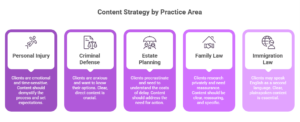
Personal injury clients are typically in an emotionally charged, time-sensitive situation. Their questions center on process, timelines, cost, and what to expect. Content that demystifies the claims process and sets realistic expectations performs strongly.
Criminal defense clients often search urgently and with anxiety. They want to know what their options are, what the charges mean, and what happens next. Clear, direct content written for someone who has never dealt with the criminal justice system before converts well here.
Estate planning clients often procrastinate. They know they need to act but haven’t. Content that addresses why delay is costly, what specific documents they need, and what happens to their family without a plan tends to move these readers toward action.
Family law (divorce, custody) clients are often doing research privately, sometimes while still living with their spouse. Content needs to be clear, reassuring, and specific about both the legal process and their rights. Avoid language that feels aggressive or adversarial.
Immigration law often serves clients who speak English as a second language. Clear, plainspoken content without legal jargon is what keeps these readers on the page long enough to call you. Overly technical language sends them to a competitor with simpler explanations.
Why Is Link-Building Important for Law Firms
Links from other websites to yours tell Google that your site is worth paying attention to. The more credible the linking site, the stronger that signal.
For law firms, the most practical and sustainable link sources are:
Legal directories. Avvo, Martindale-Hubbell, FindLaw, Justia, and Super Lawyers offer free listings that provide real citation value and, in some cases, direct referral traffic. Your state bar association’s member directory is equally important and often overlooked.
Law school and alumni sites. If you graduated from a law school that maintains an alumni directory or profiles notable alumni, a link from that page carries real weight. Law school domains have strong authority and high relevance to legal search.
Local business associations. Chamber of Commerce memberships, local business directories, and community sponsorships often come with a link back to your site. These are straightforward to earn and support local authority signals.
Legal publications and contributed articles. Writing a column or analysis piece for a state bar publication, legal journal, or respected legal blog earns links from authoritative sources. It also establishes the individual attorneys at your firm as recognized voices in their practice area, which supports E-E-A-T.
Press and media mentions. Journalists regularly need attorney commentary for news articles. Getting quoted as a legal expert builds brand recognition and earns links from news domains, which tend to carry strong authority. Tools like HARO (Help a Reporter Out) can surface those opportunities.
What to avoid entirely: any service selling “100 links for $299,” private blog networks (PBNs), and low-quality directory spam. Google has become highly effective at identifying unnatural link patterns, and a manual or algorithmic penalty on a legal website takes months to recover from and directly impacts client acquisition during that time.
Can SEO help law firms generate more leads?
Yes. But traffic and leads are not the same thing.
A law firm website can attract 5,000 visitors a month and generate almost no consultations if the site doesn’t convert. Getting the traffic is the first problem SEO solves. Converting that traffic into consultations is the second, and it’s just as important.
According to Ruler Analytics research, organic SEO delivered the second-highest conversion rate of all marketing channels for legal businesses, at 4.28%. That’s higher than paid search, social media, and most other inbound channels. Organic visitors arrive with intent. They searched for something specific, found your site, and are now reading. The quality of that attention is different from a passive ad impression.
To convert that traffic into actual consultations:
Make it easy to contact you. Your phone number should be in the header on every page, always. A “Free Consultation” button should be visible without scrolling. A contact form should take under sixty seconds to complete.
Enable click-to-call on mobile. A large share of legal searches happens on phones. If your phone number is plain text instead of a tappable link, you’re losing a percentage of those potential clients before they even think about reaching out.
Add specific trust signals. Generic statements like “experienced attorneys” don’t move anyone. Client testimonials with real names and specific outcomes, case results (where ethically permitted under your Bar rules), bar admissions displayed clearly, awards with verifiable sources, and press mentions all reduce the hesitation that stops someone from submitting a form.
Address the cost question. For most practices, the single biggest unspoken objection is “Can I afford this?” Explaining your fee structure upfront, whether you offer a free initial consultation, and whether you work on contingency (where applicable) removes the barrier that stops many people from reaching out. They’d rather see it on the page than have to ask.
Track what’s working. Set up conversion events in Google Analytics 4 for form submissions. Use a call tracking tool like CallRail to attribute phone calls to specific pages. If you don’t know which content is generating consultations, you can’t make informed decisions about where to focus.
How long does SEO take for law firms?
Most law firms start seeing meaningful movement in keyword rankings within four to six months of a well-executed strategy. Consistent lead generation from organic traffic typically starts around the six to twelve-month mark. Full return on investment, where organic search consistently performs as well as or better than paid ads, usually takes twelve to twenty-four months.
That timeline is longer than most firms want to hear. But it reflects what’s actually happening.
Legal content is classified as YMYL. Google applies more scrutiny before ranking legal pages, particularly for newer domains. There’s no shortcut around that. Authority and trust take time to establish.
Several factors affect how quickly results arrive:
Domain age and existing authority. A firm that has had an active website for eight years with some organic history will see movement faster than a brand-new domain. Google has more historical data to work with on older domains, and some level of baseline trust already exists.
Market competitiveness. Ranking for “personal injury lawyer in New York City” takes considerably longer than ranking for the same term in a mid-sized market. The depth of competition in your specific geography directly affects how long it takes to break through.
Content output and consistency. A firm publishing one thoroughly researched, well-optimized piece per month will build topical authority noticeably faster than one publishing nothing or publishing thin, generic posts. Consistency compounds.
Technical health. A site with persistent technical problems, such as poor Core Web Vitals, duplicate content across city pages, or crawl errors, will lag behind a technically clean competitor even with stronger content.
Link acquisition pace. Actively building backlinks from legal directories, bar associations, and authoritative sources accelerates ranking gains in direct proportion to the quality and relevance of those links.
The attorneys who get disillusioned with organic search are almost always the ones who expected results in sixty days. The ones who see it become their primary client acquisition channel are the ones who treated it as a long-term asset from day one and measured accordingly.
How to choose an SEO agency for your law firm
The legal SEO agency space is competitive and, frankly, has more than its share of firms that oversell and underdeliver. Here’s how to separate ones worth working with from ones that will drain your retainer.
Ask for legal-specific case studies. Anyone can say they specialize in SEO for law firms. Ask to see actual results: which keywords moved, by how much, how much organic traffic increased, and whether it translated into measurable leads. If they can’t produce specifics with real firm names or anonymized data, that’s your answer.
Check whether they understand Bar compliance. An agency writing content for your website needs to know what the ABA Model Rules of Professional Conduct require, and they need to know your state’s specific advertising rules. An agency that doesn’t know these exist has no business producing legal content.
Understand the monthly deliverables. A transparent agency can tell you exactly what they’re doing each month: how many pages of content, which technical issues they’re addressing, which directories they’re building citations on, and which keywords they’re tracking. Vague deliverables (“ongoing optimization”) are a warning sign.
Look for realistic timelines. Any agency promising page-one rankings in thirty days is either misleading you or planning to use tactics that will eventually get your site penalized. Credible agencies set realistic expectations and explain the variables involved.
Ask how they measure SEO success. An agency that reports purely on traffic and rankings without connecting those metrics to consultations and client acquisition is measuring the wrong thing. SEO investment is only justified by the business it generates.
Choosing the right agency is just as important as investing in SEO itself. We compared the best SEO companies for law firms based on legal experience, service quality, pricing, and overall reputation to help you make an informed decision.
How to measure your SEO performance
Rankings and traffic are the visible outputs. But what you actually care about is consultations and clients.
Track these metrics consistently:
Organic traffic and keyword rankings. Google Search Console shows which queries are generating impressions and clicks. Track your target keywords monthly in a dedicated rank tracking tool. Look for directional movement over three to six-month windows, not week-to-week fluctuations.
Google Business Profile insights. Your GBP dashboard shows how many people found you through local search, how many requested directions, and how many called directly from the listing. For most law firms, this is where the earliest measurable results from local SEO appear.
Form submissions and call volume. Tag contact form completions as conversion events in Google Analytics 4. Use call tracking to attribute inbound calls to specific pages and search terms. Without this, you’ll never know whether your SEO investment is generating leads or just traffic.
Cost per consultation over time. As organic traffic grows, calculate what each consultation from organic search costs you compared to one acquired through paid search. This number, tracked over twelve to twenty-four months, is the clearest argument for continued SEO investment to anyone at your firm who remains skeptical.
Why Choose Crazygraph?
Law firm SEO requires more than ranking for keywords. We build long-term authority that helps your firm appear where potential clients are searching, from Google to AI-powered search platforms. Our strategies have helped a London immigration law firm increase organic users by 146% and generated 12,600 AI search impressions in just 30 days for a Tampa personal injury firm.
You’ll work directly with experienced SEO specialists who provide clear reporting, practical recommendations, and a strategy focused on generating qualified leads, not just higher rankings.
If you’re deciding between hiring an agency or building an internal team, our guide on in-house SEO vs agency SEO for small law firms explains the costs, benefits, and long-term considerations of each approach.
What to do next
Organic search is not a quick fix. It’s a long-term channel that builds something your firm owns rather than rents.
The firms that see it become their most reliable source of new business share a few things in common. They fixed their technical foundations first. They built content that genuinely serves the questions their potential clients are asking. They earned links from credible legal sources. And they stayed consistent long enough for the investment to compound.
If you want to know exactly where your firm stands today, an SEO audit is the starting point. It shows you what’s working, what’s broken, and where the fastest opportunities are.
Ready to understand what your specific market looks like and what it would take to compete? Get a free SEO audit for your firm and we’ll show you the exact gaps in your current visibility.