

You could have the best attorneys in your city. But if your firm doesn’t appear when someone searches “divorce lawyer near me” or “law firm seo agency” in your area, none of that matters.
That’s what ranking locally solves. It puts your firm in front of people who are actively searching for legal help in your area, right now, before they’ve picked up the phone.
This guide covers everything you need to act on, starting today.
Here’s what we’ll walk through:
- What local search optimization means for attorneys and how it differs from general SEO
- The three signals Google uses to rank attorneys locally
- How to optimize your Google Business Profile the right way
- How reviews affect your local rankings and how to get them ethically
- How to build citations that strengthen your local authority
- How to create location pages that actually rank
- How to measure whether any of this is working
What is local SEO for law firms, and why does it work differently?
Local SEO is the process of improving your firm’s visibility in location-based search results. When someone searches “family law attorney near me” or “DUI lawyer in Phoenix,” Google shows results based on where that person is and which firms are most relevant, prominent, and nearby.
That’s a different calculation from how Google ranks a regular blog post or practice area page.
There are also two separate surfaces to compete for, and most firms only focus on one.
The Google Local Pack (also called the 3-Pack) is the map with three business listings that appears above the organic results for most legal searches. Getting into this pack for a competitive term like “personal injury attorney in Houston” generates more calls than ranking organically at position four or five.
Localized organic results are the traditional blue-link results that appear below the map. These rank based on the content and authority of your website pages, not your Google Business Profile. A firm can appear in the Local Pack and still be missing from localized organic results, or vice versa.
You need to optimize for both. The tactics are different. The rewards stack.
For a broader view of how local search fits into your overall SEO strategy, see our complete law firm SEO guide.
What signals does Google use to rank attorneys locally?
Google evaluates local results using three factors. Understanding them makes every tactic in this guide easier to prioritize.
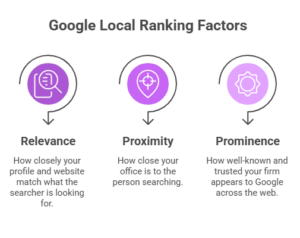
Relevance is how closely your profile and website match what the searcher is looking for. A firm with a GBP category of “Personal Injury Attorney” and a detailed services list will appear for more relevant searches than a firm listed only as “Lawyer.”
Proximity is how close your office is to the person searching. You can’t move your office for SEO purposes. But you can strengthen the other two signals to compensate when you’re further away.
Prominence is how well-known and trusted your firm appears to Google across the web. Reviews, backlinks, directory citations, and brand mentions all feed into this signal. A firm with 80 Google reviews, consistent directory listings, and links from the state bar association will outrank a comparable firm with none of those.
Every tactic below maps to one or more of these three signals. When you know which signal a tactic targets, you know why it matters.
How do you optimize your Google Business Profile for an attorney?
Your GBP is the single highest-leverage asset in local search. According to research from Legal Brand Marketing, GBP optimization influences approximately 35% of local ranking decisions. Get this right before anything else.
Start with your primary category
This is the most important field on your profile, and most firms get it wrong. “Lawyer” is too broad. “Personal Injury Attorney,” “Criminal Defense Attorney,” or “Family Law Attorney” are the right choices for most practices. Google uses your primary category to match your profile to specific searches, so specificity directly affects which queries you appear for.
Add secondary categories for every practice area you handle
If you practice both family law and estate planning, add both. Google uses additional categories to broaden your match potential across relevant searches.
Write your GBP description for a potential client, not for an algorithm
You have 750 characters. Use them to explain what your firm does, which areas you serve, and what clients can expect when they call you. Avoid stuffing it with repetitive keywords. Write it the way you’d explain your firm to a stranger at a bar association event.
Fill out your services list completely
List every practice area and sub-service. A personal injury firm should list auto accidents, slip and fall, wrongful death, workers’ compensation, and any other specific case types it handles. Google reads this list to determine whether your profile matches specific queries.
Upload photos that actually tell a story
Photos of your office exterior, reception area, conference room, and attorneys make your listing feel real. Profiles with photos receive significantly more clicks than those without. The exterior shot is worth prioritizing specifically because it helps clients recognize your building when they arrive.
Use Google Posts consistently
Short updates are published through the GBP signal to Google that your profile is actively managed. Post firm news, legal tips, or community activity at least twice a month. Active profiles receive preferential treatment in local ranking over dormant ones.
Check your Q&A section regularly
Anyone can submit questions to your profile, and anyone can answer them, including people who don’t work for your firm and may not know the correct answer. Review this section monthly, answer legitimate questions in your own words, and flag or remove inaccurate answers.
For a step-by-step breakdown of every GBP field and feature, our Google Business Profile optimization guide for law firms covers each one in detail.
How do client reviews affect local rankings?
Reviews are a direct local ranking signal. Moz’s Local Search Ranking Factors research consistently places review signals among the top determinants of Local Pack position. Volume, rating, recency, and whether you respond all play a role.
A firm with 85 reviews at 4.7 stars will consistently outrank a comparable firm with 12 reviews at 3.9 stars, assuming other signals are similar. That gap is not a minor difference. It’s the difference between appearing in the 3-Pack and not appearing at all.
How to ask for reviews without violating your Bar rules
In the US, the ABA Model Rules of Professional Conduct permit asking satisfied clients for reviews. What you cannot do is offer any form of compensation, discount, or incentive in exchange. Most state bars follow this rule, though specific language varies. Check your state bar’s advertising guidelines before setting up any automated review request system.
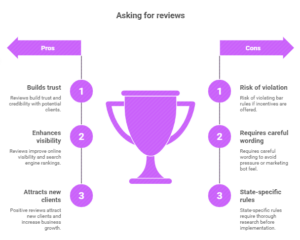
The most effective approach is a simple, direct ask in a follow-up email or text after a case closes. Something like: “If you were happy with how we handled your case, a Google review would mean a lot to us.” That’s it. No pressure, no incentives, no scripts that feel like they were written by a marketing bot.
How to respond to negative reviews
Respond to every review, positive and critical alike. Keep responses professional and brief. Never include specific case details in your response; confidentiality obligations apply even in a public reply. A calm, constructive response to a negative review often does more for your credibility with prospective clients than the review itself does to damage it. Someone who sees you handle criticism professionally is more likely to trust you with a legal matter.
What are local citations, and why do they matter?
A citation is any online mention of your firm’s Name, Address, and Phone number (NAP). Google cross-references your NAP across the web to verify your location and confirm your firm is a real, operating business. Inconsistent information across directories confuses that process and suppresses local rankings.
The most common cause of NAP problems is office moves. A firm relocates, updates its website and GBP, but leaves dozens of old directory listings untouched. Google now sees two addresses associated with the same firm and downgrades confidence in both.
Even small inconsistencies matter. “Suite 400” vs. “Ste 400” or “Street” vs. “St” can create discrepancies that affect your visibility.
The directories that matter most for attorneys:
| Directory | Why it matters |
| Avvo | High authority, ranks independently, referral traffic |
| Martindale-Hubbell | Industry-standard legal directory, strong domain authority |
| FindLaw | Ranks highly for attorney searches, with significant referral value |
| Justia | Strong for organic attorney citations |
| Super Lawyers | Peer-recognized, trusted by clients as a quality signal |
| State Bar directory | Very high authority, directly relevant, and often required for members |
To audit your existing citations, search Google for your firm name alongside any previous phone number or address. If old listings surface, contact the site administrator and request an update. Tools like Whitespark and BrightLocal can automate much of this process.
For a complete walk-through of how to build and clean citations for your firm, see our guide on local citation building for law firms.
How do you create location pages that actually rank?
If your firm serves clients in multiple cities, or if you want to rank in cities beyond your immediate office location, you need dedicated location pages. Each one targets a specific city and practice area combination.
Here’s what separates a location page that ranks from one that doesn’t.
The title tag should be specific. “Personal Injury Attorney in Dallas | [Firm Name]” tells Google exactly what the page is about and tells a searcher whether they’ve landed in the right place. Avoid generic titles like “Serving Texas” or “Areas We Cover.”
The content must be genuinely unique per location. This is where most multi-location firms fall short. They build ten city pages with identical content, swap the city name, and wonder why none of them rank. Google sees through this immediately. Each page needs content that is specific to that location: the local courts where you file, the counties you serve, case types common in that area, or anything that makes the page substantively different from the version targeting the next city over.
Include local signals in the body copy. Mention the relevant state court, the county, and any geographic details that confirm your firm’s presence in or familiarity with that market. These signals tell both Google and the reader that this page was written for their location, not repurposed from another.
Match your footer address to your GBP exactly. If your GBP lists “1200 Main Street, Suite 300,” your website footer should list the same. Character-for-character consistency between your on-site address and your GBP strengthens local trust signals.
How do you convert local search traffic into consultations?
Getting traffic is one problem. Converting it is another.
Local search visitors arrive with intent. Someone who searched “DUI attorney near me” and clicked your location page is not browsing passively. They have a problem and they’re looking for someone to call. The question is whether your page makes that easy or adds friction.
Three things that remove friction immediately:
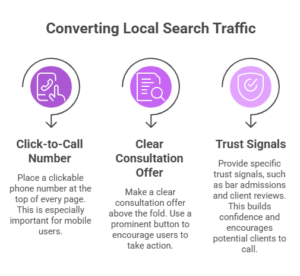
A click-to-call phone number at the top of every page. On mobile, plain text phone numbers don’t work as tap-to-call links. Make sure your number is formatted as a clickable link. Most local legal searches happen on phones, and a number that requires copy-pasting loses calls.
A clear consultation offer above the fold. “Free consultation” or “Call for a free case review” with a button that actually stands out. Don’t bury it. Don’t make anyone scroll to find it.
Trust signals that are specific, not generic. “Experienced attorneys” is noise. Bar admissions, years of practice in a specific area, case results (where your state Bar rules permit), and client reviews cited with real names do actual work. They address the unspoken question every potential client has before they call: Can I trust this firm with my problem?
For guidance on what content types convert best at each stage of the client decision process, our law firm content strategy guide breaks down exactly what to publish and why.
How do you measure whether your local rankings are working?
You need numbers, not gut feelings.
Google Business Profile Insights shows how many people found your listing through local search, how many requested directions, how many clicked through to your website, and how many called directly. Check this monthly. Direction requests and calls are your clearest early indicators that local visibility is translating into actual interest.
Google Search Console shows which search queries are generating impressions and clicks on your location pages. Filter by city-specific terms to see whether your geo-targeted pages are gaining traction.
A dedicated rank tracker lets you monitor exactly where your target terms (practice area + city combinations) are ranking week over week. Tools like Whitespark’s Local Rank Tracker or Semrush’s Position Tracking show Local Pack and organic position separately, which matters because you can be winning one and losing the other.
Call tracking attribution is how you close the loop between SEO activity and new clients. A tool like CallRail assigns unique phone numbers to specific pages, so you know not just that calls increased but which pages generated them. Without this, “rankings are improving” is a guess. With it, it’s a number.
What the timeline actually looks like:
- 30 to 60 days: GBP impressions increase after profile cleanup and early review growth
- 3 to 4 months: Local Pack movement for secondary, less competitive terms
- 6 to 12 months: Stable Local Pack position for primary competitive terms, measurable intake increase from organic and local channels
Local SEO is not fast. But it compounds in a way that paid search never does. The rankings you build in month eight don’t disappear when you stop writing checks.
Ready to see exactly where your local visibility stands?
Most firms have fixable gaps in their local search visibility. A missing category here, an inconsistent citation there, a location page that’s invisible because the content is too thin. These problems are solvable. But you have to know where they are first.
We offer a free local search audit for attorneys. We’ll review your GBP, check your citation consistency, and show you exactly what’s limiting your Local Pack visibility right now.
Get your free local audit and find out what’s holding your firm back.