This case study demonstrates a successful lead generation campaign for a client in the highly competitive Australian solar panel industry. Our focus was on drastically reducing the cost per lead while maintaining a high quality of inquiries, showcasing the power of strategic Facebook advertising and continuous optimization.
Our Goal
The primary objective was to significantly reduce the cost per lead for solar panel inquiries, ensuring a sustainable and efficient client acquisition process for our partner.
Strategy & Planning
Our approach to the Australian solar panel market involved a meticulous and data-driven strategy. Understanding the specific needs and pain points of potential solar customers in Australia was paramount. Our planning included:
Initial Data Collection & Analysis
Even without extensive prior data for this specific client, we leveraged industry benchmarks and initial broad targeting to quickly gather actionable insights.
Targeted Audience Segmentation
We developed detailed audience profiles, considering demographics, interests, and behaviors relevant to solar panel adoption in Australia. This allowed us to tailor our messaging precisely.
Compelling Ad Creative Development
Working closely with the client, we crafted visually appealing and benefit-driven ad creatives that resonated with the target audience, highlighting the advantages of solar energy.
A/B Testing of Ad Sets & Creatives
Continuous testing was fundamental. We systematically tested different ad copies, visuals, calls-to-action, and audience segments to identify the most effective combinations.
Rigorous Optimization
Daily monitoring of campaign performance, lead quality, and cost metrics allowed for real-time adjustments and budget reallocation to top-performing ad sets.
Results
The optimization journey, while challenging, yielded remarkable improvements in lead cost efficiency.
Initial Cost Reduction Phase
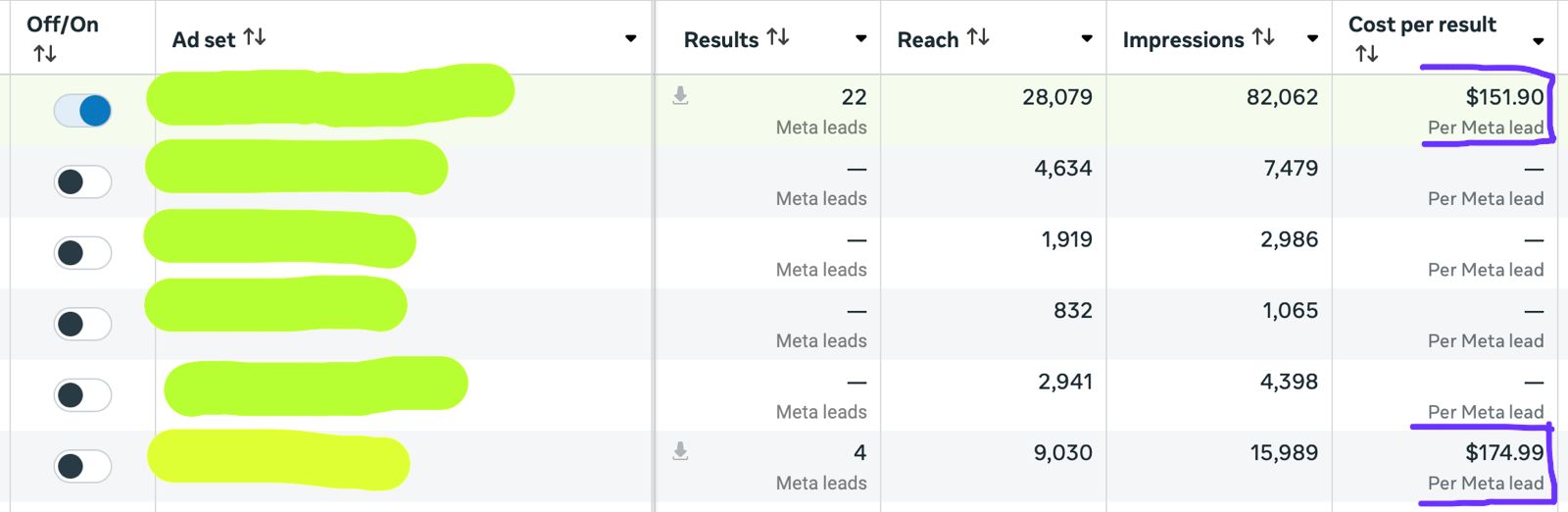
As demonstrated above, our initial strategic adjustments led to a significant improvement, bringing the cost per lead down from $175 to $151. This initial success provided a strong foundation for further optimization.
Advanced Optimization & Further Cost Reduction
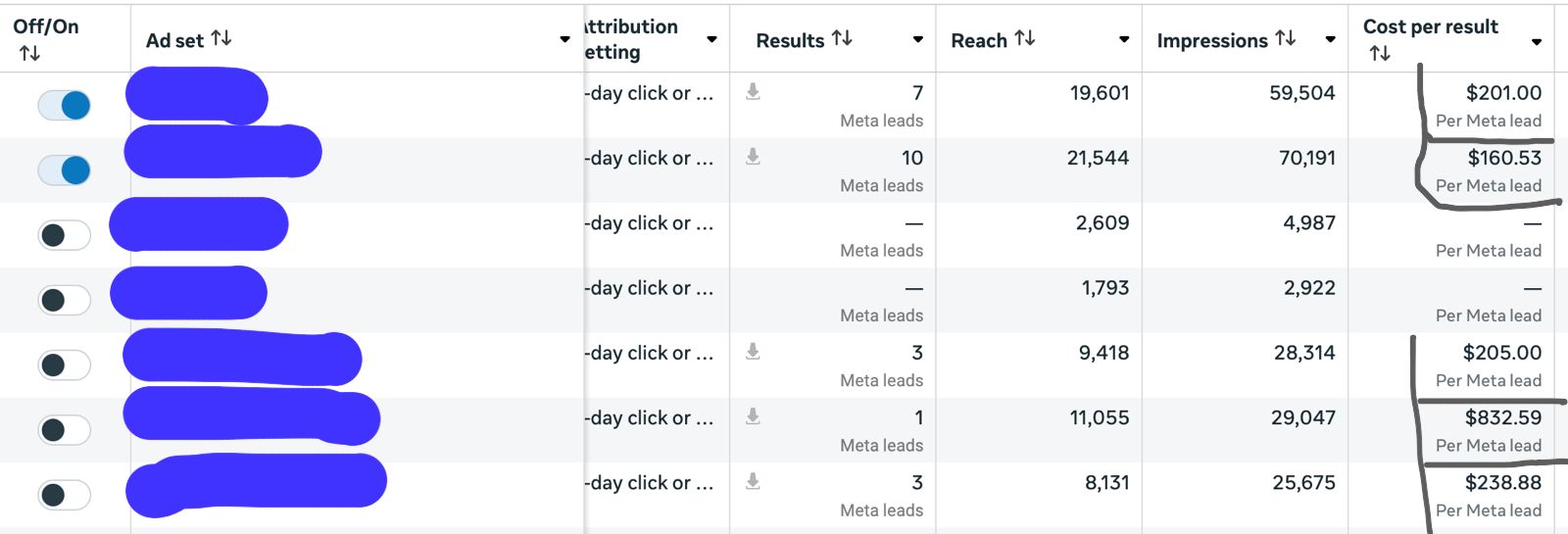
Through relentless A/B testing and granular optimization, we achieved even more substantial reductions. We successfully took lead costs that were initially as high as $832 and $238 and brought them down to an impressive $160 and $201, respectively. This demonstrates a significant increase in efficiency and a strong return on ad spend for our client.
Conclusion
This case study emphatically proves that with a precise blend of strategic planning, targeted execution, and ongoing optimization, even highly competitive industries like solar panel installation can achieve outstanding results with Facebook Ads.
By systematically driving down the cost per lead from initial high points to efficient figures of $151, $160, and $201, we delivered high-quality leads and established a scalable framework for client acquisition in the Australian market. This success underscores the power of data-driven marketing to transform advertising spend into tangible business growth.
Ready to optimize your lead generation and scale your business? Book a meeting today, work with Crazygraph, and make your brand impossible to ignore!