
AI Success of Crumpsall’s Pharmacy

Client Type

Local pharmacy
Location: Crumpsall, Manchester, UK

Objective

Move beyond traditional local rankings and position the business as the default answer across modern search surfaces, including:

  • Google Maps
  • Google AI Overview
  • Generative and ChatGPT-style answers

The goal was not just to increase traffic or rankings, but also to improve selection and recommendations.

The Problem

Most local SEO strategies still focus on:

Blue link rankings and basic Google Business Profile optimisation

But in 2026 and beyond, users increasingly search using:

  • “Near me” intent
  • Conversational queries
  • AI-assisted results that do not always send clicks

The risk for local businesses is simple:

If AI systems do not understand and trust your entity, you disappear, even if you rank.


Our Strategy

We aligned pharmacy SEO, AEO, and GEO into a single execution framework.

Instead of optimising pages in isolation, we focused on:

  • Clear entity definition
  • Service-level intent matching
  • Trust and eligibility signals AI systems rely on

What We Implemented

1. Local Entity and Service Clarity

We ensured Google and AI systems clearly understood:

  • Who the business is
  • Where it operates
  • Which medical and pharmacy services it offers

This included:

  • Correct service categorisation
  • NHS Pharmacy First eligibility alignment
  • Consistent entity signals across local surfaces

2. “Near Me” and Local Intent Optimisation

We optimised the business to match real search behavior, not just keywords.

For example:

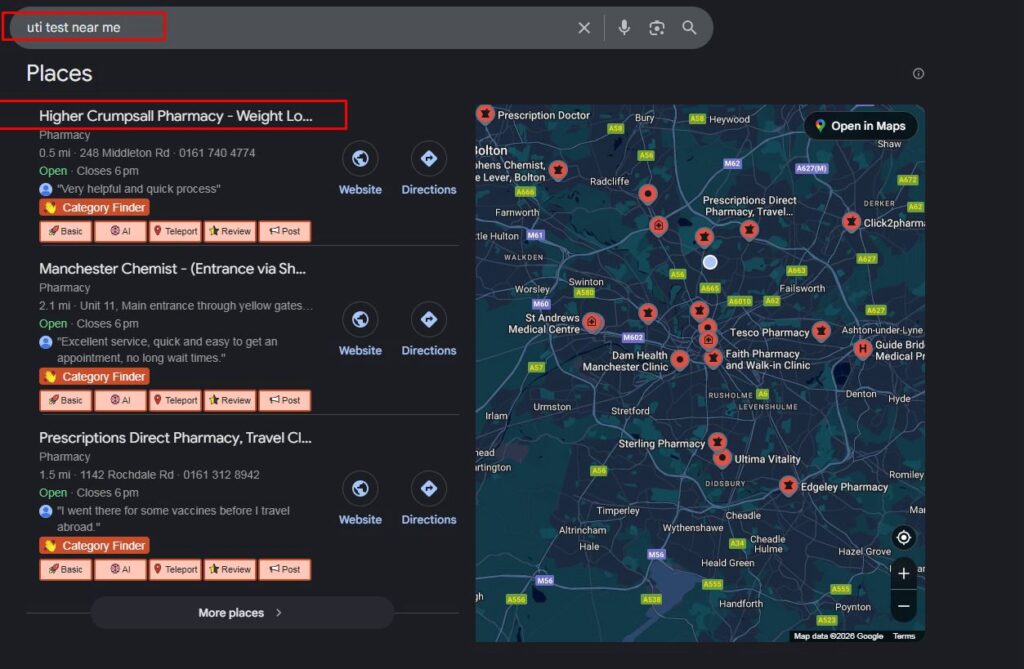
  • “UTI test near me”
  • “UTI testing near me”
  • Location-based health queries

This allowed the business to surface naturally in proximity-driven searches.
higher crumpsall pharmacy's map pack result

Screenshot 1: Google Maps result showing the pharmacy appearing prominently for “UTI test near me” searches.

3. AI Overview Eligibility (AEO)

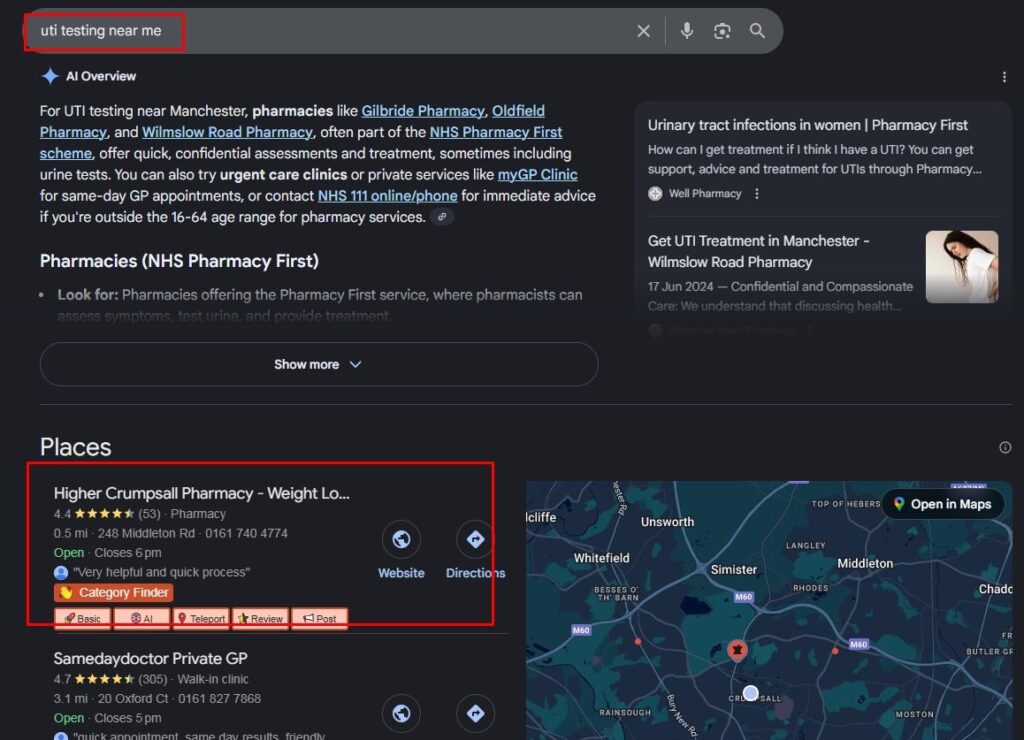
For queries like “UTI testing near me”, Google’s AI Overview highlights pharmacies offering NHS Pharmacy First services.

Because of the way we structured entity and service signals:

The pharmacy is referenced as a relevant option

It aligns with Google’s AI-generated guidance

This is Answer Engine Optimisation in action.
higher crumpsall pharmacy's map pack result

Screenshot 2: Google AI Overview recommending pharmacies, including our client, for UTI-related searches.

4. Generative Search Visibility (GEO)

We tested conversational prompts such as:

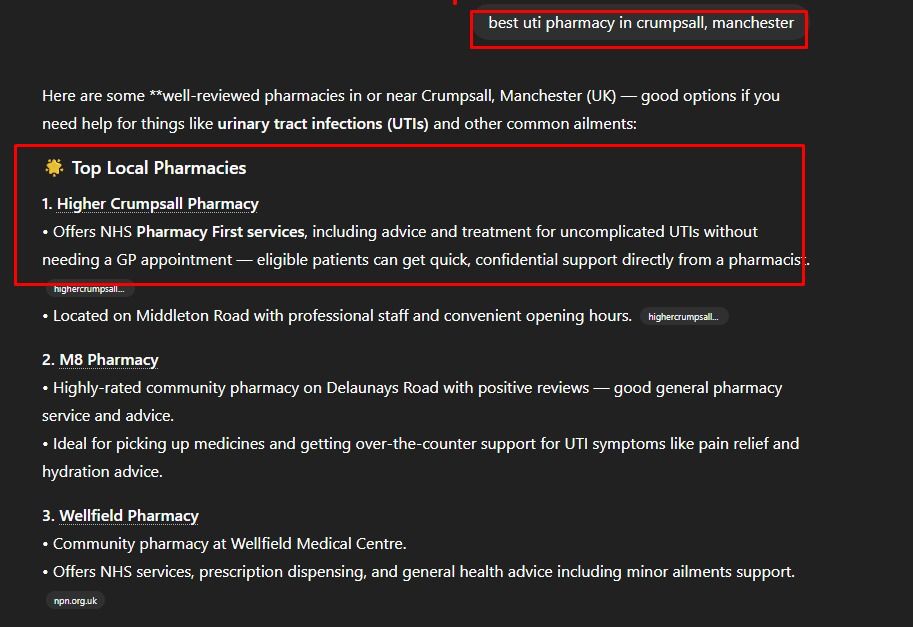
“Best UTI pharmacy in Crumpsall, Manchester”

And the result is impressive. The pharmacy appears as the top local recommendation.

At this stage, the brand is no longer just ranking.
It is being used as a source by generative systems.
higher crumpsall pharmcy appears in chatgpt result

Screenshot 3: Generative answer listing the pharmacy as the top local option.


Results Summary

The pharmacy now appears across:

  • Google Maps for “near me” searches
  • Google AI Overviews for service-related queries
  • Generative and ChatGPT-style answers for local recommendations

This creates visibility even when:

No website click happens, and the user relies entirely on AI-generated responses.

Why This Worked

This was not the result of short-term tactics, tool-driven automation, and volume-based content.

It worked because we aligned:

  • Entity clarity (who, what, where)
  • Real local intent and questions
  • AEO-friendly content structure
  • GEO trust signals, such as reviews, services, and eligibility

In short, Local SEO, AEO, and GEO worked together, not in silos.

Why This Matters for Agencies

Search is no longer just about rankings.
It is about being selected, cited, and recommended.

This is the same execution framework we now run behind the scenes for other SEO agencies, acting as their delivery team for:

Local SEO, AI search visibility, generative engine optimisation (GEO).

Ready to Become the Default Choice in Your Local Market?

Let’s position your business where AI, Maps, and generative search select and recommend you first. Stop competing for rankings and start owning visibility where decisions are actually made. Contact us today, and let’s build your authority across modern search.

Why our clients love
working with us!

Related Case Studies

Ready to take your
business to the next level?

Methodology

How we measure AI visibility

What every number in Beaconly means, how it’s calculated, and where its limits are.

Which AI we ask

  • Gemini, through Google’s official Gemini API. Right now Gemini answers from its own knowledge, without live web search, so answers don’t list sources.

  • Every question is asked as a fresh conversation, with no memory or personal history, set to the market (country) you chose.

What we ask

The questions a buyer would ask when looking for what you sell — like “best CRM for a small agency”. We write starter questions from your website; you can edit, delete or add your own. Questions don’t include your brand name, so we measure whether AI brings you up on its own.

Mentioned

Your brand counts as mentioned when its name, one of its other names you added, or its website address appears in the answer as a whole word. The same rule applies to every competitor, so the comparison is fair.

Position

The order in which tracked brands are first named in the answer: 1 means you were named before any tracked competitor. We show how often you’re named first, 2nd–3rd, later, or not at all.

Recommended

Mentioned and described positively. A separate AI step reads each answer and rates how it talks about each brand: positive, neutral or negative.

Visibility and small samples

Visibility is the share of answers that mention you. With fewer than 20 answers a percentage can mislead (1 answer changes it by 20 points), so we show the count instead — for example “3 of 5”.

Perception scores

We ask the AI to compare you with your competitors on the traits you choose, then score what the answer says about each brand from 1 to 10, using only the answer — not our own opinion. “What AI says about you” groups the reasons AI recommends you, its criticisms, and who it prefers instead, counted across your latest tracked answers.

Brand facts check

We ask the AI about your brand directly and compare each factual claim with the facts you gave us. Claims your facts don’t cover are marked “not covered”, never “wrong”.

AI traffic

The snippet on your site counts visits whose referrer is an AI assistant (ChatGPT, Perplexity, Gemini, Copilot, Claude and others), or that carry ChatGPT’s utm_source tag. Some apps hide the referrer, so the real number is usually higher. No cookies are used and no IP addresses are kept.

Page watch

We re-read the pages you watch once a day and look for your brand name, other names, or website address in the page text. Some sites block automated visits; we tell you when we can’t read a page.

Answers vary

AI assistants give different answers to the same question, and API answers can differ from what a signed-in person sees in the app (memory, location, model updates). That’s why we track over time and link every question so you can ask it yourself.

Spotted something wrong?

Email [email protected] with the page or brand, and we’ll look into it.