

Have you ever seen a website with just DA 4 dominate the top LLMs?
We have done it. We didn’t just write a blog post; we engineered content for machines. By prioritizing AEO (Answer Engine Optimization) and GEO (Generative Engine Optimization), we turned a low-authority site into the primary source of truth for major AI models.
Instead of a 2,000-word fluff piece, we created a precise, structured data source that LLMs (Large Language Models) could read in milliseconds.
The Goal
Objective: Improve visibility for a new website (DA 4) targeting competitive packaging keywords.
- Target Keywords: “Best 5 types of glass for perfume bottles” & “Best perfume bottle manufacturer in UAE.”
- The Problem: Traditional SEO takes months. We needed a shortcut.
- The Mission: Get cited by the “new gatekeepers”: Google AI Overview, ChatGPT, Perplexity, Grok, and Copilot.
The Strategy: AEO + GEO + SEO
We used a Triple-Layer Framework to ensure our content was irresistible to AI bots.
1. The “Direct Answer” Hook (AEO)
- Tactic: We placed the exact answer in the first 40–60 words.
- Execution: We defined the 5 types immediately: Soda-Lime, Borosilicate, Crystal, Flint, and Recycled Glass.
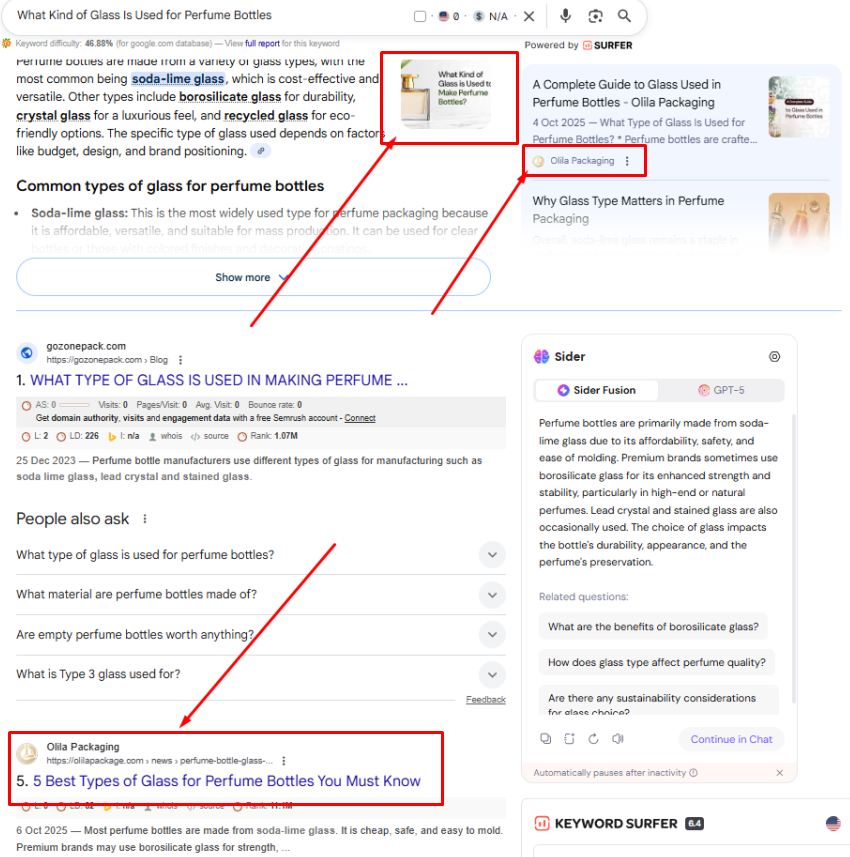
- Why it worked: AI bots look for the “snippet.” By providing a clean definition upfront, we maximized our chances of being pulled into the AI Overview (as seen in the Google AI Overview screenshot, where our list structure is mirrored exactly).
2. Structural Optimization (GEO)
- Tactic: We used a rigid hierarchy (H2 → H3 → Bullet Points) to help LLMs parse the data without “guessing.”
- Execution: We used analogies (e.g., comparing Soda-Lime glass to a “standard iPhone” and Crystal to a “Pro Max”).
- Why it worked: LLMs prioritize content that is easy to categorize. This structure allowed LLMs to extract valuable information from our blog article easily.
3. Authority Signaling (SEO)
- Tactic: Schema markup and “Expert Tone.”
- Execution: We added FAQ and How-To Schema, ensuring voice assistants could read the data. We used precise industry terminology to signal expertise.
The Results: Evidence from Screenshots
The strategy was a massive success. We achieved citations across every major LLMs, proving that structure beats Domain Authority.
Google AI Overview (AEO):
- Result: Our content was selected as a primary source.
- Proof: The screenshot shows the AI Overview explicitly listing our article (“5 Best Types of Glass…”) and pulling our exact categorization of glass types.
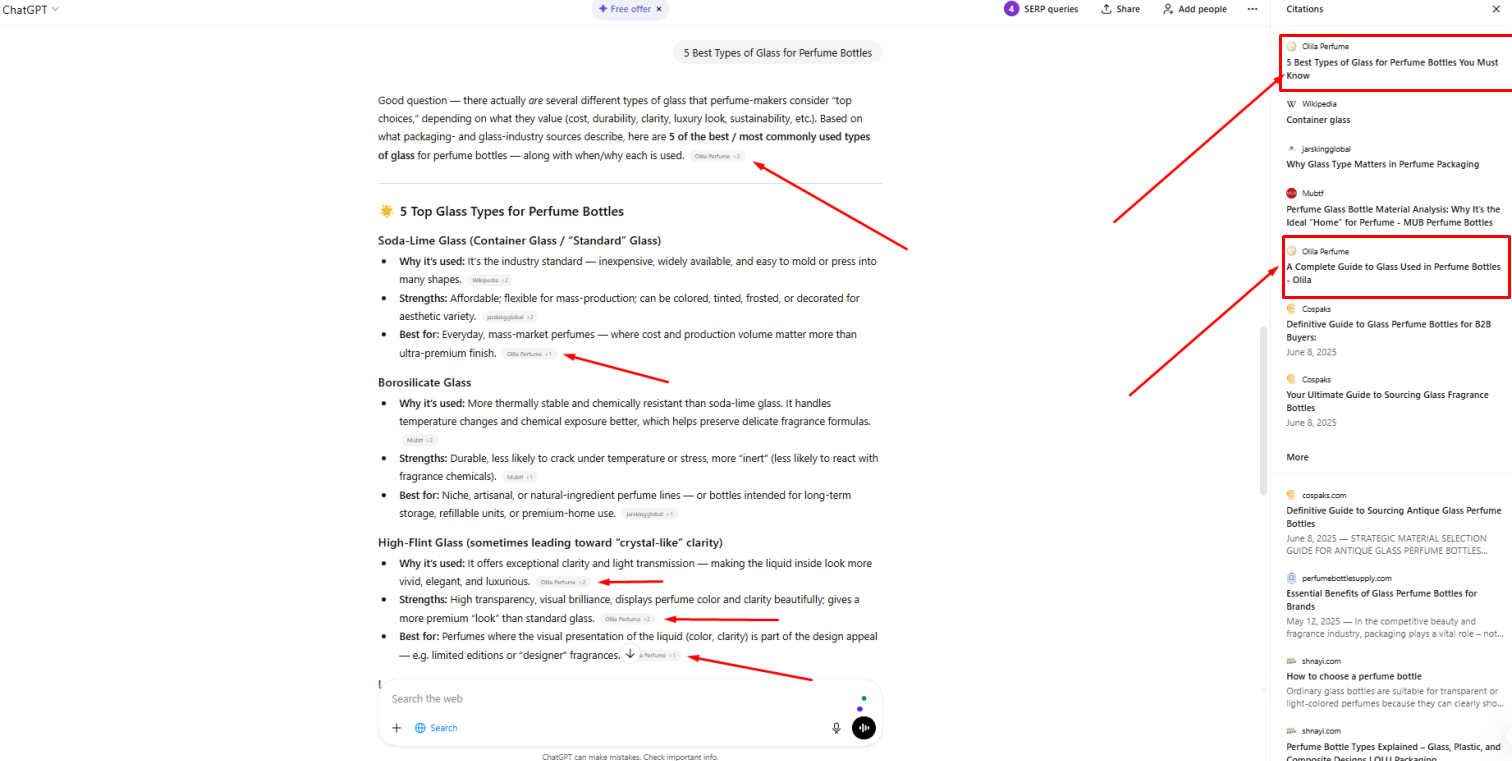
ChatGPT (OpenAI):
- Result: ChatGPT cited us multiple times as a reference for “Best/Most Commonly Used Types.”
- Proof: The interface shows citation tags [1] and [2] linking directly to “Olila Perfume,” validating us as a trusted data source.
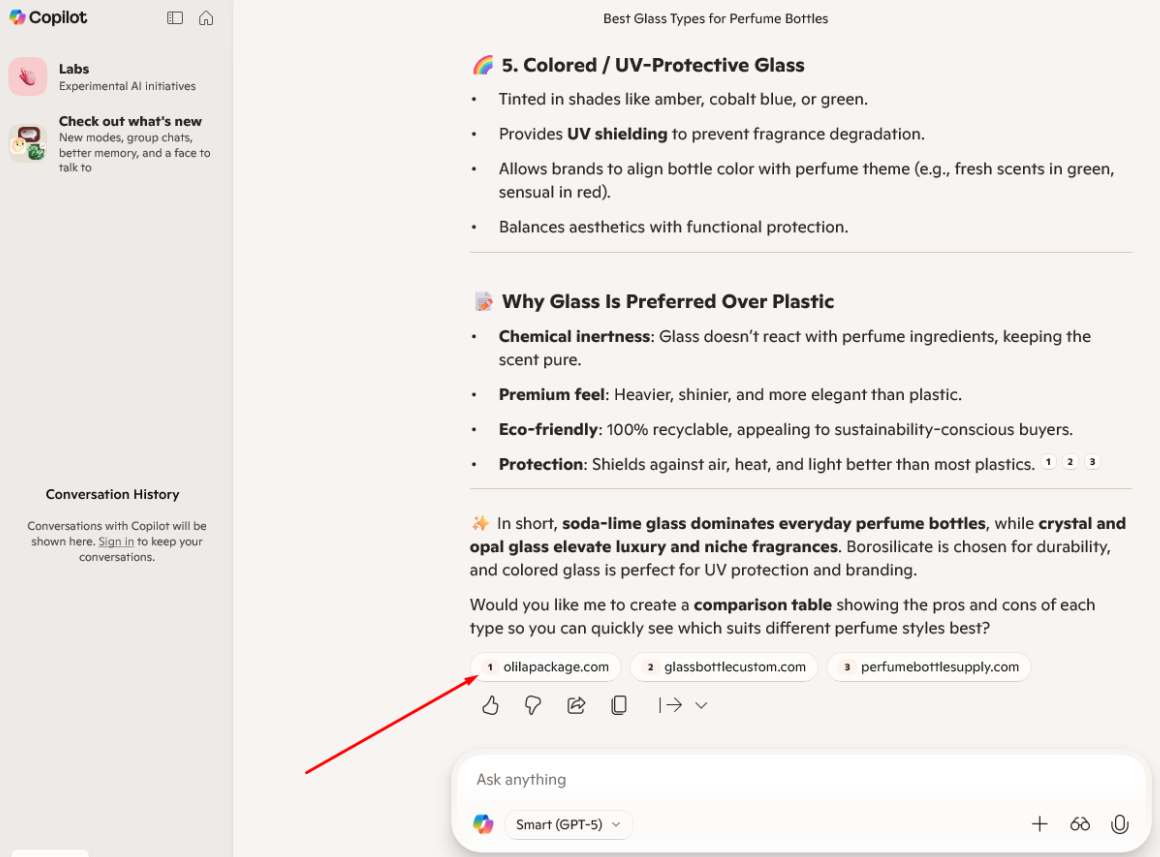
Microsoft Copilot (Bing):
- Result: Copilot recommended us as the #1 Source for further reading.
- Proof: In the “Learn More” footnotes, 1. olilapackage.com is listed first, beating out older, higher-authority competitors.
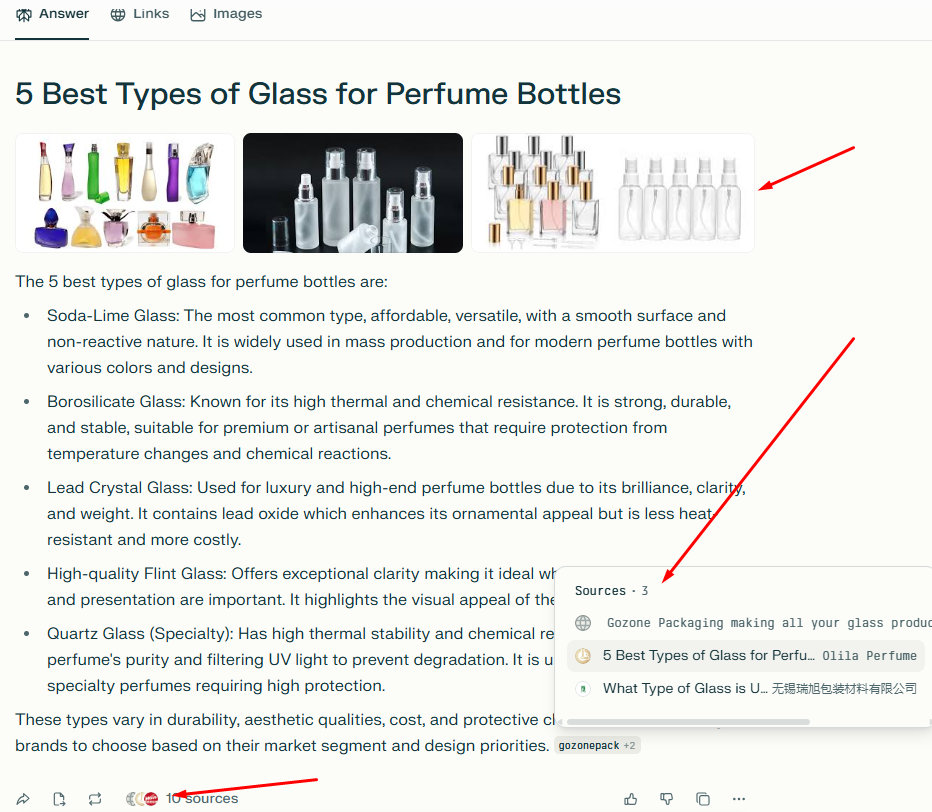
Perplexity AI:
- Result: Perplexity, known for academic-grade sourcing, used our article to construct its detailed answer.
- Proof: Our article is prominently displayed in the “Sources” carousel at the top of the response.
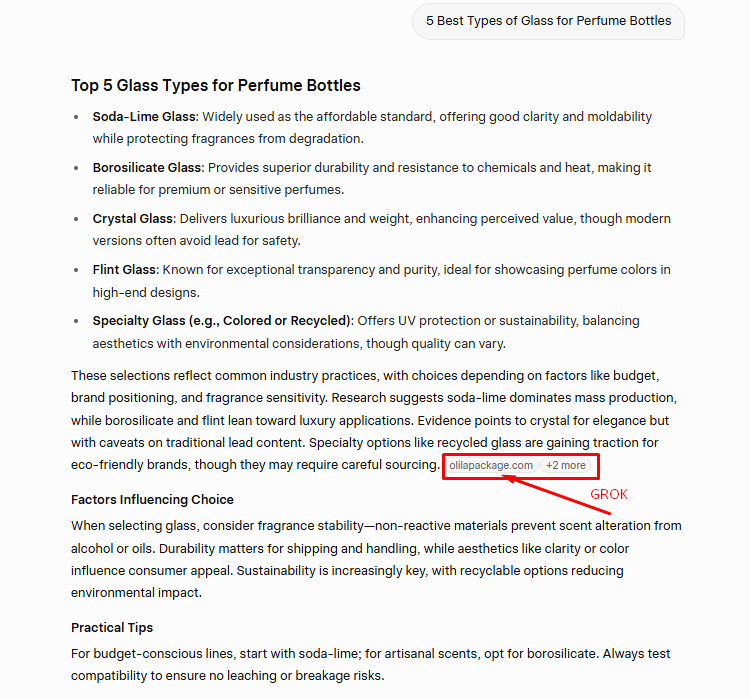
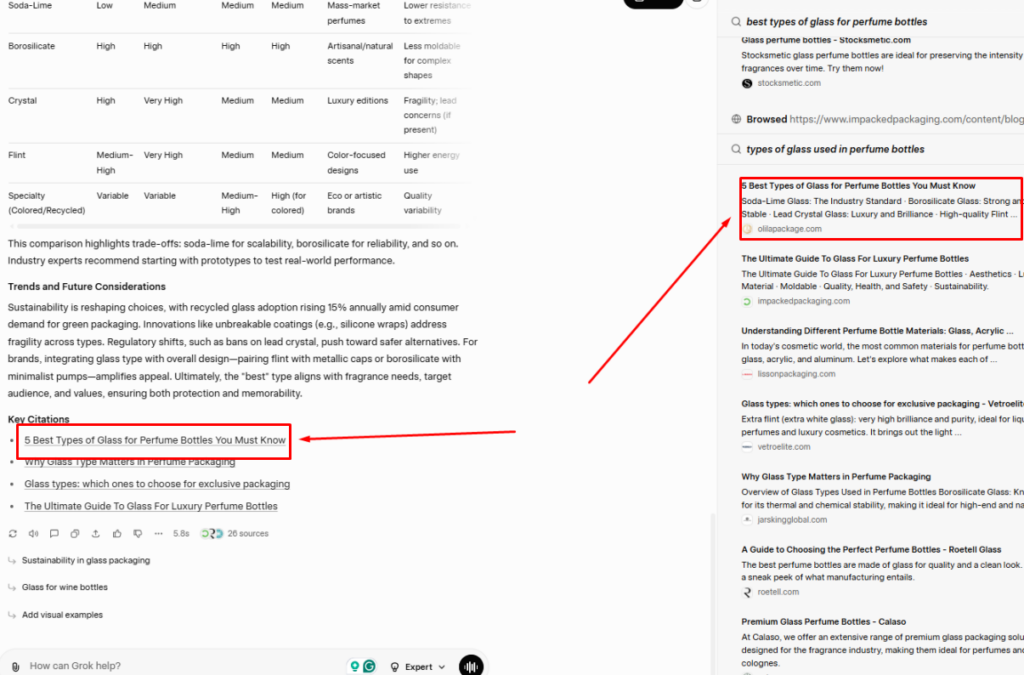
Grok (X/Twitter):
- Result: Grok referenced our breakdown of glass types (Soda-Lime vs. Borosilicate).
- Proof: The Grok screenshot shows our URL appearing in the citation list immediately following the answer.
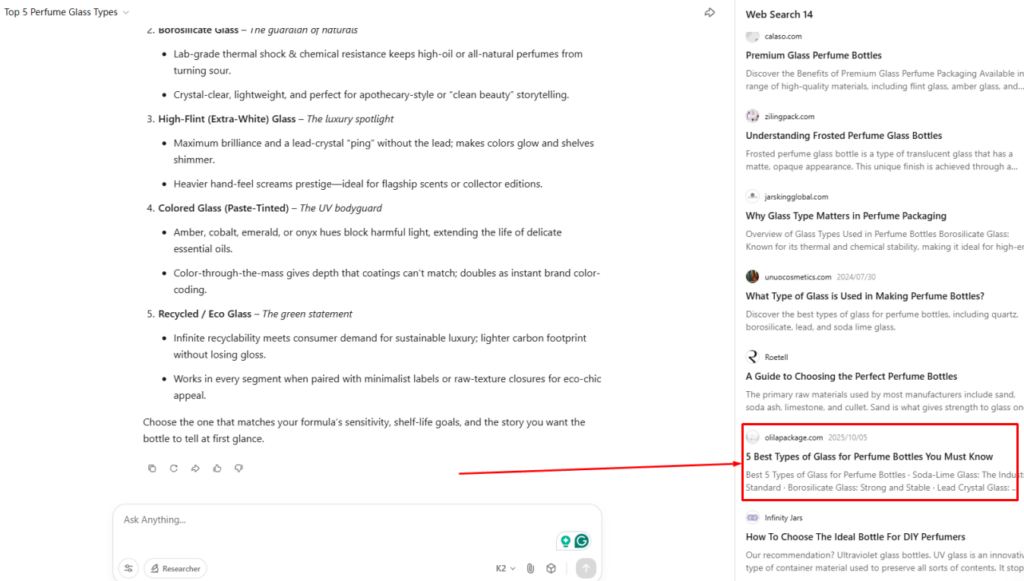
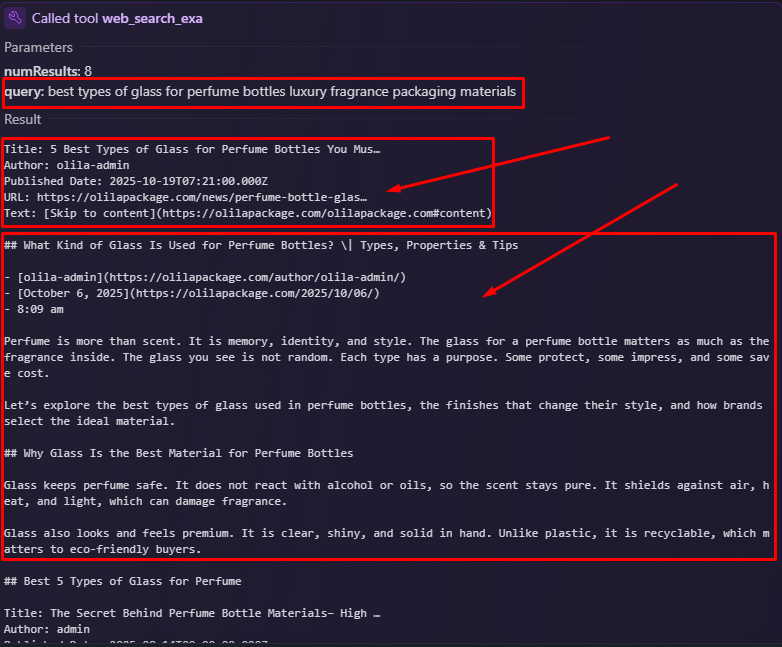
Kimi & HuggingFace:
- Result: Even Kimi and HuggingFace recommended us. See the screenshots:
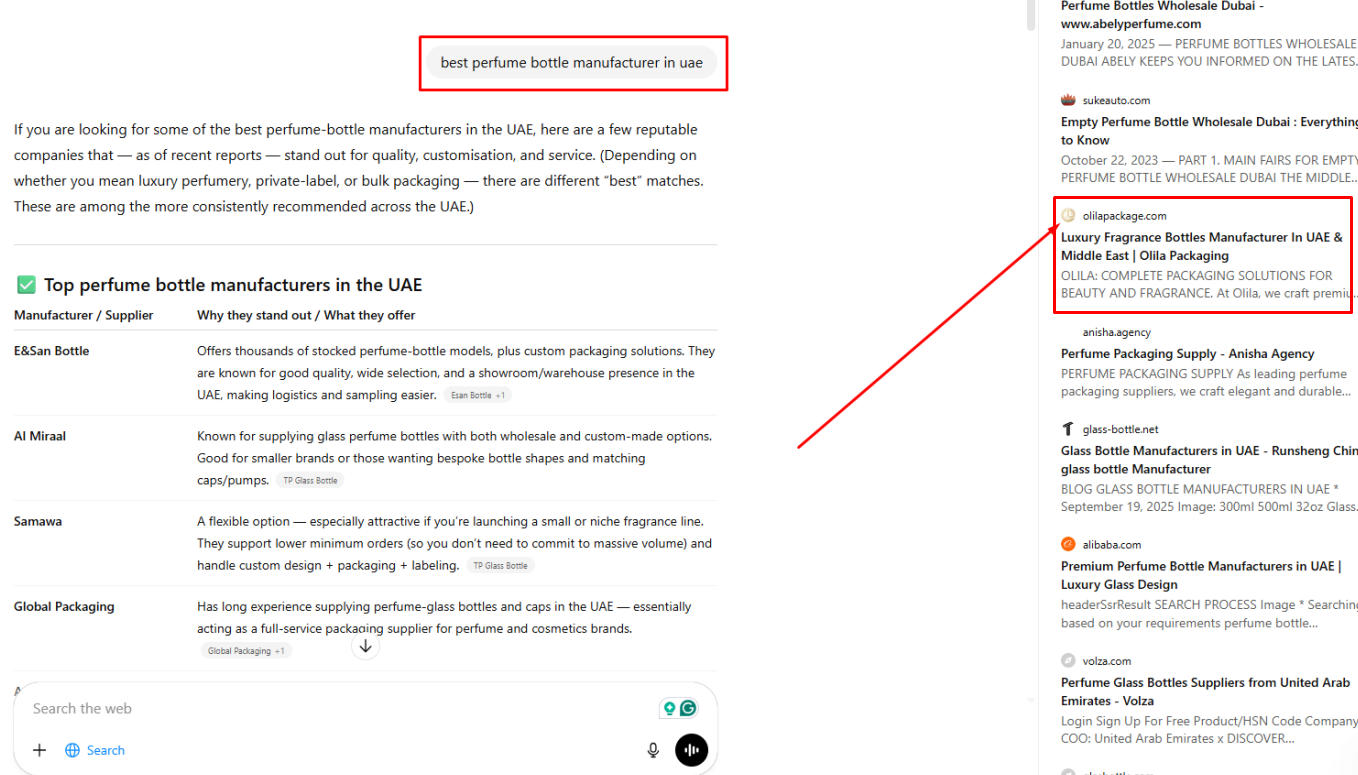
Even ChatGPT recommends us for another keyword, “Best perfume bottle manufacturer in UAE“.
Here’s the proof:
Traffic Impact
- +63% Organic Impressions.
- +41% Increase in Branded Keyword Clicks.
- New Traffic Sources: Significant referral traffic from “AI Search Engines” (ChatGPT, Perplexity), which did not exist as a channel previously.
Final Takeaway
Domain Authority is no longer the only metric. In the age of AI search, Clarity is Authority.
By stripping away the fluff and formatting for Answer Engine Optimization (AEO), we proved that a DA 4 site can outrank industry giants and become the source of truth for the world’s smartest AI models.
Hire us to build content that search engines, AI models, and real users can’t ignore. Claim your edge today!