


Nearly 78% of legal queries now trigger a Google AI Overview – the highest trigger rate of any category according to SE Ranking research. That means your firm doesn’t just compete in the blue links anymore. You’re competing in three places at once: the AI overview, the local map pack, and organic results.
This guide covers 7 effective SEO strategies for small law firms. You’ll learn:
– How to dominate local search using your Google Business Profile
– Why dedicated practice area pages outperform generic service pages every time
– Bigger firms consistently overlook the long-tail keyword approach
– How to build E-E-A-T signals that convert prospects, not just rank
– The technical fixes that move the needle fastest
– How to earn quality backlinks without a large agency budget
– How to get your firm cited in AI Overviews and LLM responses like ChatGPT
What Makes SEO for Small Law Firms Different?
Small law firm SEO is, by nature, hyper-local, and it’s an advantage.
Large firms run national campaigns. They build thin location pages for cities they’ve never set foot in, trying to appear local everywhere. You actually are local. Your office is in the neighborhood. Your clients come from the same zip codes. Your name is known in the community.
That specificity is something no multi-location firm can fake on a budget.
The other shift worth noting: the 2026 legal SERP now delivers three distinct result types – an AI-generated answer at the top, a local map pack, and traditional organic results. Each one requires a different approach. The firms that treat them as one combined problem are the ones building real, sustainable visibility. The firms that focus on only one will keep wondering why their traffic plateaus.
1. Optimize Your Google Business Profile as a Local SEO Asset
Your Google Business Profile (GBP) is the engine behind every map pack appearance, every “near me” result, and every phone call from Google Search, without the prospect ever visiting your website.
Most firms claim their profile and stop there. That’s the equivalent of opening your office, putting a sign on the door, and never turning on the lights.
Here’s what a properly optimized GBP looks like:
- Name, Address, and Phone (NAP) consistent across your GBP and every directory you’re listed in – Avvo, FindLaw, Justia, Martindale-Hubbell
- Primary category set to “Law Firm,” with secondary categories specific to your practice (e.g., “Personal Injury Attorney,” “Criminal Justice Attorney”)
- Business description using your city and primary practice area in the first sentence – Google reads this.
- Services section filled in – not just one line
- Google Posts are published weekly – case outcomes (anonymized), firm news, and quick legal FAQs.
- Q&A section seeded with your own questions, answered with keyword-rich, accurate responses
Reviews are especially important. Google’s local algorithm weights both the volume and recency of reviews. A firm with 15 reviews from 2021 will often lose to a firm with 12 reviews from the past 90 days. At case close, send a text message asking for a review – not an email. Text requests get three times higher response rates.
Respond to every review. Positive and negative. That response activity signals engagement with Google and trust to prospective clients browsing your profile.
For a more detailed breakdown of how local SEO for law firms works across citations, directories, and proximity signals, we’ve covered it separately.
2. Do Keyword Research the Way Clients Actually Search
The assumption most attorneys make: they target “divorce lawyer [city]” and call the research done. That’s a start. But the searches that drive the highest-converting traffic tend to look very different.
People searching for legal help are usually scared, confused, or under time pressure. Their queries reflect that.
There are four keyword types your firm needs:
| Keyword Type | Example | Why It Converts |
| Practice Area + Location | “personal injury lawyer Chicago” | High intent, local |
| Long-Tail Question | “how much does a DUI lawyer cost in Ohio” | Specific intent, lower competition |
| Urgency Query | “need a criminal defense lawyer today” | Acute need, ready to call |
| Comparison Query | “public defender vs private attorney” | Research stage, still warm |
Long-tail question keywords are where small firms have a genuine structural advantage. Larger firms target volume. They skip queries with fewer than 500 monthly searches. You shouldn’t. Those queries convert at a higher rate, and your competition for them is thinner.
Use Google Search Console’s “Queries” report first – it shows which searches already lead to your site and where you can push for more. Then use tools like Ahrefs or Semrush to expand. Look at “People Also Ask” boxes in your target search results – those question clusters feed directly into AI Overviews.
Map each keyword cluster to one specific page. One keyword group per URL. Never mix practice areas on a single page, hoping to capture both – you’ll capture neither.
3. Build Practice Area Pages That Actually Rank
One practice area deserves one dedicated page. This is not optional if you want to rank.
A generic “we handle family law, criminal defense, personal injury, and immigration” page gives Google no strong topical signal. It gives prospects no direct answer to their specific problem. It ranks for nothing meaningful and converts even less.
Every practice area page should cover:
- The specific legal problem and what causes it
- How your firm approaches that case type
- Jurisdiction-specific detail – state statutes, filing deadlines, relevant local courts
- A clear call to action specific to that situation
For a personal injury firm, this means separate pages for car accidents, slip-and-fall accidents, medical malpractice, and wrongful death.
For a family law practice, separate pages for contested divorce, child custody, and adoption.
Each page also needs an attorney bio tie-in. Not a generic footer credit – an actual attribution that signals first-hand experience with that case type. Google’s E-E-A-T framework (Experience, Expertise, Authoritativeness, Trustworthiness) now determines whether your content gets cited by AI systems, not just ranked in organic results. Clear authorship is part of that signal.
Add an FAQ section at the bottom of each practice area page. Format it with question headings and direct answers. This structure qualifies for FAQ schema markup, which improves your chances of appearing in AI Overviews.
4. Earn Backlinks Without a Big Budget
You don’t need 400 backlinks to rank locally. You need 20 authoritative, locally relevant ones.
This is where small firms consistently waste money – chasing mass-link outreach campaigns built for national e-commerce, not neighborhood law practices.
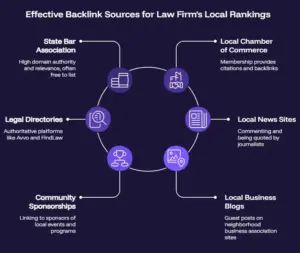
Here are the backlink sources that actually move local rankings:
- State Bar Association directory – high domain authority, highly relevant, often free to list
- Local Chamber of Commerce – membership gives you a citation and usually a backlink
- Legal directories – Avvo, FindLaw, Martindale-Hubbell, and Justia all carry authority
- Local news sites – comment as a legal source on relevant stories; one journalist quote = one strong regional backlink
- Community sponsorships – Little League teams, local charities, and school programs often link to sponsors
- Local business blogs – guest posts on neighborhood business association sites, not law blogs
Small firms underuse the digital PR angle. Send a short, expert comment to your local newspaper or city business journal when a legal topic is in the news. If they quote you, you get a citation. That single mention from a regional publication carries more local ranking weight than 10 directory submissions.
Search for your firm name in Google with quotes. If any site mentions you without linking to your website, contact them and ask them to add a link to your website. Unlinked brand mentions are easy wins.
One real example of what focused link building produces: when we worked with a London immigration law firm for their SEO campaign, a targeted strategy combining entity signals, local citations, and backlinks produced 146% traffic growth – without a large budget or mass outreach.
5. Create Content That Builds Topical Authority
Your law firm blog is not meant to demonstrate how smart you are. It’s for answering what your future clients are searching for at 11 pm when they’re worried about their case.
Google ranks sites with topical authority – meaning comprehensive, accurate coverage of a specific legal subject area – above sites with scattered posts on unrelated topics. Choose two or three practice area clusters and go deep. Don’t post one article about family law and then three about business contracts.
The content formats that work best for law firms in 2026:
- FAQ-format posts – feeds People Also Ask and AI Overview extraction
- Local legal guides – “What Happens After a DUI Arrest in [City]?” performs because it combines local relevance with genuine informational value
- Comparison posts – “Contested vs. Uncontested Divorce: Which Applies to You?” capture mid-funnel searchers comparing their options.
- Case outcome explainers – anonymized results with outcome context signal real-world experience
Here’s the part most firms miss:
Writing for AI Overviews requires a specific structure. According to SE Ranking, nearly 78% of YMYL legal queries trigger an AI Overview.
To get cited in one, you need question-formatted H2 headings, direct answers in the first sentence of each section, and FAQ schema on your pages. The answer has to stand alone – Google’s AI extracts it without surrounding context.
Cite authoritative sources where relevant. State statutes, court websites, and ABA guidelines. That sourcing signals E-E-A-T trustworthiness to both Google and AI systems.
Publish at a sustainable pace. One well-researched post per month beats ten thin posts published in a sprint.
6. Fix the Technical SEO Issues That Cost You Rankings
Your content strategy fails if Google can’t crawl and understand your site.
Technical SEO doesn’t have to be complex. For most small law firm websites, a handful of fixes account for the majority of ranking impact:
- Page speed – Core Web Vitals target: Largest Contentful Paint under 2.5 seconds. Over 65% of legal searches are conducted on mobile devices. Slow sites lose.
- Mobile-first design – Google indexes the mobile version of your site, not the desktop version
- HTTPS – Non-secure sites are effectively penalized in Google’s trust assessment
- Site structure – Keep it flat: homepage → practice area page → blog post – no deeply nested URLs.
- Schema markup – Add LegalService, LocalBusiness, FAQ, and Attorney schema. This tells Google exactly what your pages cover.
- Google Search Console – Set it up, verify your site, submit your XML sitemap, monitor for crawl errors and 404s
That last one is free and takes 20 minutes. Yet a significant number of law firm websites never use it.
7. Track What Actually Matters
Rankings feel satisfying to track. They’re also misleading.
A firm ranking #3 for “personal injury lawyer” in a city with 50 monthly searches isn’t generating cases. A firm ranking #7 for a cluster of long-tail queries adding up to 400 monthly searches — and converting at 4% – might be.
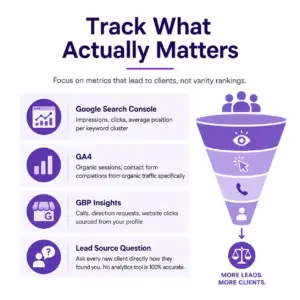
Track what leads to clients:
- Google Search Console – impressions, clicks, average position per keyword cluster
- GA4 – organic sessions, contact form completions from organic traffic specifically
- GBP Insights – calls, direction requests, website clicks sourced from your profile
- Lead source question – ask every new client directly how they found you. No analytics tool is 100% accurate.
Set realistic expectations by timeline:
| Milestone | Realistic Timeline |
| Impressions Growth in Search Console | Month 2–3 |
| Map Pack Appearances for Target Keywords | Month 4–6 |
| Consistent Organic Inquiries (2–5/Month) | Month 9–12 |
SEO compounds. The firm that starts today and stays consistent will have a significant visibility advantage over the firm that waits for the “right time.”
Conclusion
Small firms don’t need to outspend larger competitors to outrank them. They need to out-focus them.
Your physical presence in a community, your genuine client relationships, and your specific practice area expertise are things no national firm can replicate with a cookie-cutter location page. The strategies above build on those real advantages.
Start with your Google Business Profile this week. Get the fundamentals right. Then build from there, layer by layer.